Available fittings include tees, wyes, reducers and elbows
Perforated pipe is available with polyester knit filter (sock)
Size
Coil Size
Non-Perforated
Perforated
Couplers
4″
100′ or 250′
x
x
x
6″
100′
x
x
x
8″
80′
x
x
x
Double Wall SLHDPE
Heavy-duty corrugated pipe with a smooth interior
Both AASHTO-grade resins and recycled-grade resins are available
Comes in 20-foot sections
Each 20-foot section includes one bellend
Size
Non-Perforated
Perforated
Couplers
Flared End Sections
Elbows
6″
x
x
x
22 1/2º, 45º, 90º, Tee
8″
x
x
x
22 1/2º, 45º, 90º, Tee
10″
x
x
x
22 1/2º, 45º
12″
x
x
x
x
22 1/2º, 45º, 90º, Tee
15″
x
x
x
22 1/2º, 45º, 90º, Tee
18″
x
x
x
22 1/2º, 45º, 90º, Tee
24″
x
x
x
22 1/2º, 45º, 90º, Tee
30″
x
x
36″
x
x
42″
x
x
48″
x
x
60″
x
x
What is HDPE Pipe?
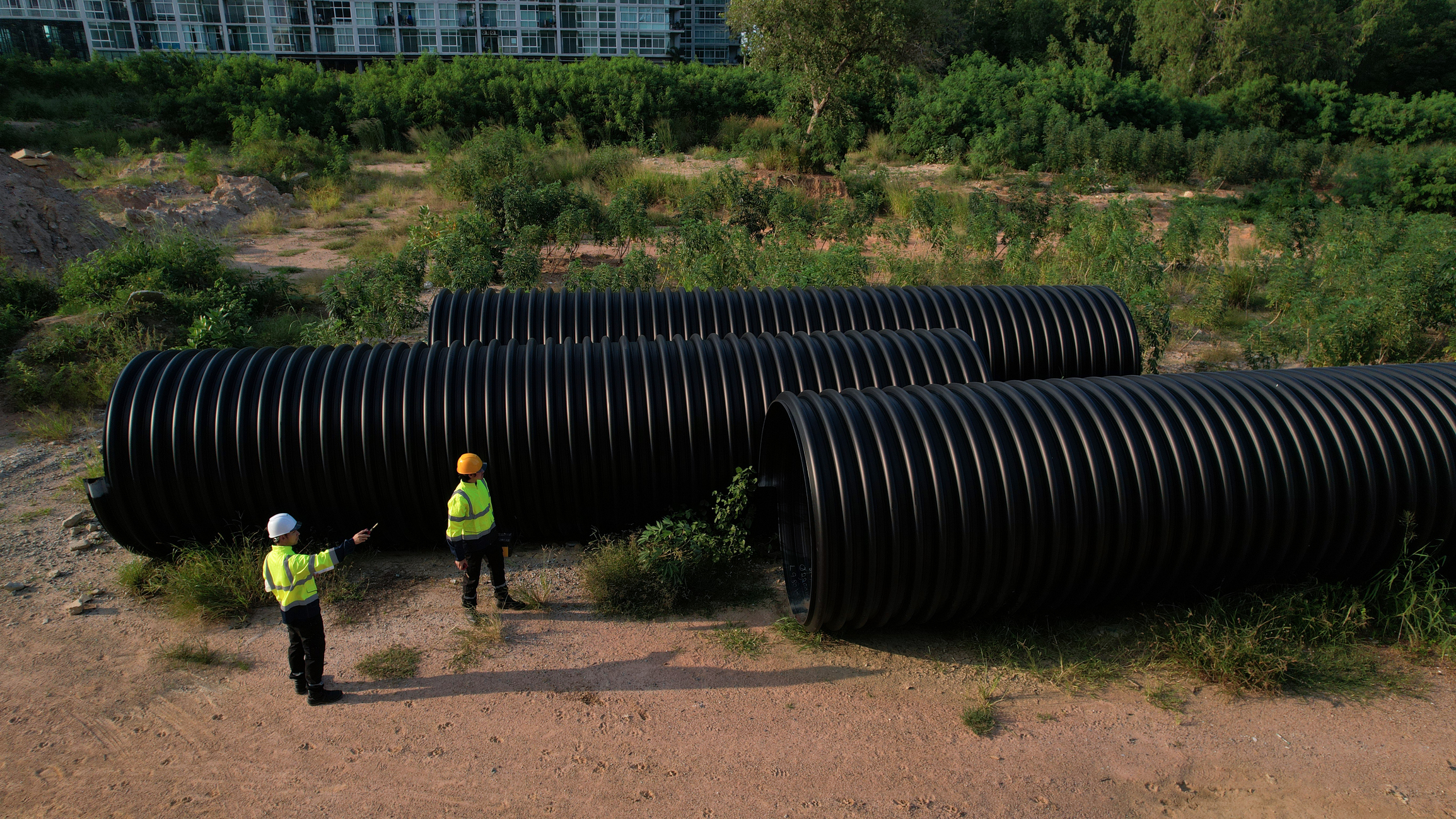
High Density Polyethylene (HDPE) Pipe is a heavy-duty corrugated pipe used for storm sewers, culverts, stormwater storage, and water quality management. HDPE corrugated pipe is quickly becoming the go-to choice among contractors, engineers and customers for a wide variety of applications, including those in oil, mining, agricultural, landfill, HVAC, marine, industrial and municipal projects.
Our options include:
AASHTO M252-compliant 3- to 10-inch corrugated HDPE pipe for culverts, storm sewers and subsurface drainage.
AASHTO M294-compliant 12- to 60-inch HDPE pipe for subsurface drainage, culverts and storm sewers.
ASTM F405-compliant 3- to 6-inch corrugated HDPE pipe and fittings for septic field leach beds and soil drainage.
ASTM F667- compliant 3- to 24-inch corrugated HDPE pipe and fittings for subsurface draining and culverts.
ASTM F2306-compliant 12- to 60-inch corrugated HDPE gravity-flow solutions for subsurface drainage and storm sewers.
ASTM F2648-compliant 2- to 60-inch HDPE pipes and fittings.
What Are the Benefits of Using HDPE Pipe?
Due to its many beneficial qualities, HDPE pipe has long been used as an abrasion-resistant material in mining applications. These benefits include:
Because storm pipes are required to transport a number of hazardous chemicals, it’s essential that they do not leak. HDPE corrugated storm pipes achieve leak resistance with heat fusion.
HDPE pipes consist of self-restrained joints and do not require thrust blocks or restraint harnesses except where the pipe itself adheres to a non-polyethylene system.
HDPE double-wall corrugated pipe also offers a more environmentally friendly footprint because it has a long life span and is chemical and corrosion-resistant, non-toxic and ideal for trenchless installation methods.
HDPE pipe can maintain a high flow coefficient throughout its service life of 50 to 100 years. Because it’s smoother than cast iron, ductile iron, steel or concrete, a smaller-diameter HDPE pipe can produce the same volumetric rate at equivalent pressures.
HDPE pipes allow for a bending radius of 20 to 25 times the outside diameter of a pipe. High-density polyethylene pipe systems require fewer fittings than other systems and can be welded into leak-free pipe runs, providing businesses with substantial savings on equipment and labor. Additionally, the pipe is light and manufactured in long lengths, allowing you to save significantly on installation costs.
This pipe is highly resistant to abrasion, corrosion, chemicals and soil and sewage conditions.
Users can expect a service life of at least 100 years in most typical drainage applications.
Applications of Double Wall Corrugated Pipe
HDPE storm pipes are commonly used for agricultural, residential, highway, golf course and farm applications.
Other applications of HDPE corrugated pipe include:
Irrigation: Sprinkler irrigation, including crops, lawns and gardens; flood irrigation, such as suction and delivery pipes in pump sets; drip irrigation including nurseries, orchards and plantations
Water supply: Service pipes, water mains, distribution and potable water supplies
Electrical installations: Conduits for cables
Ducting: Extraction of fumes, telecommunication and air conditioning and refrigeration
Sewage and industrial effluent disposal: Sanitary systems, domestic sewage systems; fertilizer and petrochemical industries
Drainage pipes: Sub-soil water, waste and water mains and surface and rainwater
Things to consider when developing your site’s strategy
How to Install HDPE Pipe
A successful result starts with the proper installation of the right pipe and backfill. As with any flexible pipe, HDPE requires the correct soil-pipe interaction for strength and performance, reinforcing the need for accurate installation and backfilling materials and techniques.
Choosing the right materials helps you create a solid foundation for your project. Select a material that’s granular, offers little to zero plasticity, and meets ASTM class and soil group guidelines. You can narrow options down further based on cost and availability, avoiding any materials with large clumps of dirt, rocks or other matter. Preferred materials include those meeting Classes IA, IB and II grades since they are stiffer, fill quickly, compact easily and provide the most support. These traits may also result in faster construction.
A snug surrounding with compacted backfill and bedding material helps uniformly distribute vertical load and safeguard against pipe deflection by creating passive resistance.
When your configuration includes multiple pipes running parallel to each other, you must allow adequate spacing between them to ensure you can accurately compact the backfill to improve the foundational structure. A standard industry gauge is to use the greater of 12 inches or half the pipe’s nominal diameter. Increase these distances if required to achieve the correct compaction of backfill and bedding.
HDPE perforated pipe is essential for gravity-flow water management in numerous applications. AASHTO separates perforated pipe into two designations — Class I and Class II — to determine the guidelines that apply to their construction and the applicable use cases. Familiarizing yourself with HDPE specifications and standards can help you identify the right choice for your application.
Class I perforated pipe is partially perforated, with a solid surface length running above the invert to promote effective flow. It features one round perforation in each corrugation row positioned parallel to the pipe’s axis. Each perforation row appears symmetrically on each side of the unperforated flow channel.
Class II perforated pipe is also called fully perforated or standard pipe. The perforations can be round or slotted and appear evenly spaced along the pipe’s circumference and length. This configuration is suitable only for subsurface drainage and is the standard choice unless Class I pipe is specified for design or application reasons.
Product Ordering Information
Get more information about ordering pavement maintenance products and more from D.B. Krieg with our FAQs. Please contact Daniel B. Krieg, Inc. by filling out the form below, or by calling us at one of our locations.