The post The Optimal Commercial Pavement Maintenance Calendar for Central PA appeared first on Daniel B. Krieg.
]]>Central PA’s freeze-thaw cycles demand precision when it comes to pavement maintenance services. In our region, temperatures swing from sub-freezing winter conditions to intense summer heat – and that constant expansion and contraction places ongoing stress on asphalt surfaces. Over time, that stress widens cracks, weakens the base, and accelerates pavement deterioration.
Many property managers fail to know the right temperature windows for sealcoating and crack filling. Applying sealcoat too early, filling cracks during peak heat, or striping before the surface is fully dry, are all missteps that can waste your maintenance dollars.
This seasonal guide outlines when to schedule commercial pavement services in Central PA so materials cure properly, protection lasts longer, and emergency repairs are avoided. By aligning maintenance with regional weather patterns, you extend pavement life, stabilize long-term costs, and protect one of your property’s most valuable assets.
When to Schedule Sealcoating in Central PA
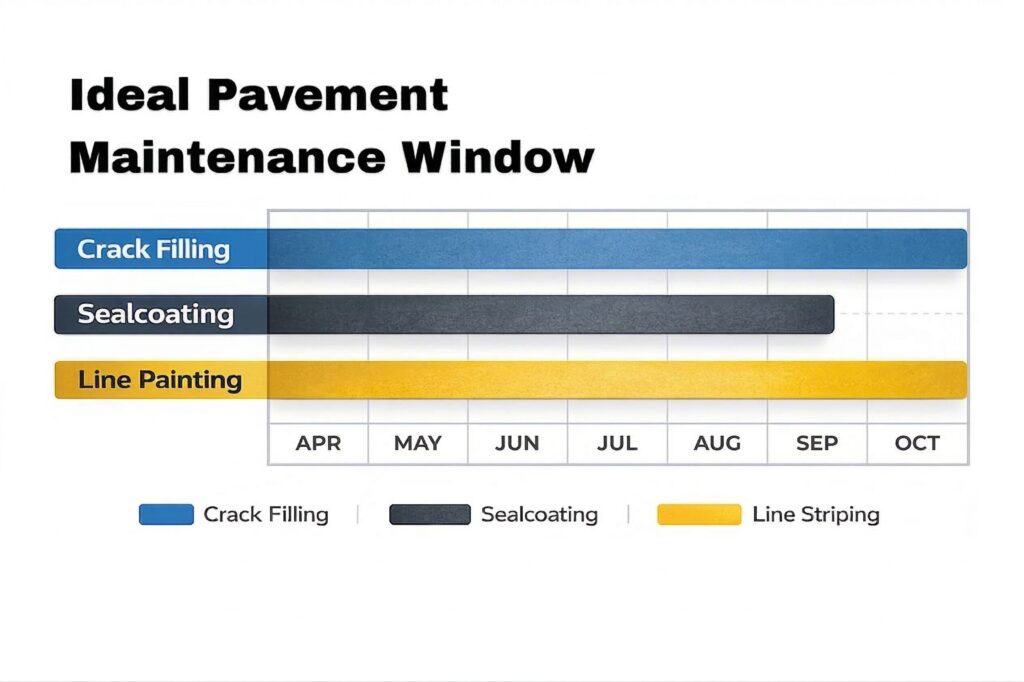
For commercial properties in Central PA, the optimal window for asphalt sealcoating runs from May through September.
Sealcoating protects asphalt pavement from oxidation, fuel damage, UV exposure, moisture intrusion, everyday traffic wear, and early aging. Without routine sealcoating, asphalt dries out, becomes brittle, and begins cracking prematurely. Over the lifespan of a parking lot or roadway, neglecting this protective layer can lead to total maintenance costs reaching two to three times the original installation investment.
Sealcoating requires specific conditions to cure properly and provide the protection your pavement needs. For proper curing and adhesion:
- Ambient temperatures must reach at least 55° Fahrenheit
- Temperatures must remain at or above that level for 24 to 48 hours after application
- Overnight lows cannot dip below the curing threshold
- No rain should occur during the curing period
- Pavement must be completely dry prior to application
If temperatures drop overnight and the material freezes before fully curing, the sealcoat can flake, peel, or fail within months. In Central PA’s climate, consistent curing conditions are most reliable from late spring through early fall.
Daylight length also plays a role. As fall progresses, shorter days reduce curing time and increase the risk of incomplete bonding. This is another reason early planning is essential.
How Often Should Commercial Pavement Be Sealcoated
Daniel B. Krieg suggests sealcoating commercial pavement every 4 to 5 years.
The timing depends on:
- Traffic volume
- Exposure to fuel or hydraulic fluids
- Plowing frequency
- Drainage conditions
- Surface age
High-traffic properties such as retail centers, medical facilities, and industrial sites may require shorter intervals to maintain optimal protection.
Sealcoating is not simply about improving appearance. It is a long-term asset management strategy designed to preserve structural integrity and delay costly reconstruction.
Explore our seal coating services to help protect asphalt surfaces from moisture, oxidation, and everyday wear.
When To Schedule Crack Filling In Central PA
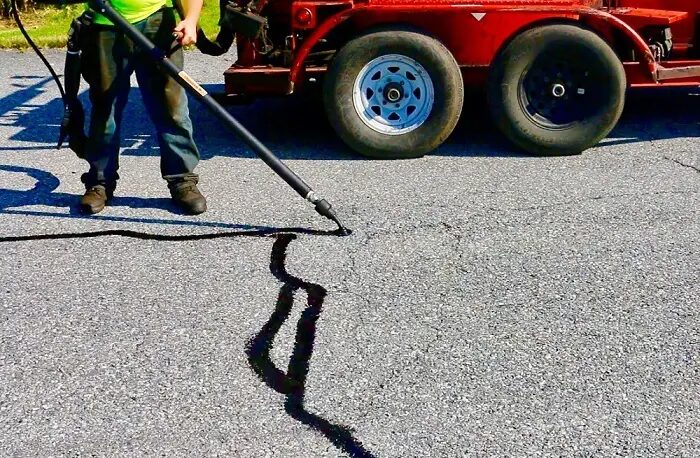
The ideal seasons for commercial crack filling are Spring and Fall, when temperatures are moderate and asphalt is naturally contracted.
Timing matters because water infiltration is the single greatest threat to pavement longevity. In Central PA, crack filling is not optional maintenance – it is structural protection.
Once water enters cracks and reaches the base layer, freeze-thaw cycles begin to undermine structural integrity. Water expands as it freezes, creating voids beneath the surface. Over time, this leads to structural failure, alligator cracking and potholes that require far more expensive repairs than proactive crack filling.
Why Spring and Fall Deliver the Best Results for Crack Filling
Crack filling delivers the best results during cooler weather in the Spring and Fall, and the science behind this timing is straightforward.
When temperatures drop, asphalt contracts. This contraction opens cracks to their widest point, allowing crack filler to penetrate deeply into the void. As temperatures rise in summer, the asphalt expands and the filler compresses, creating a tight seal that prevents water infiltration.
Summer may seem like convenient timing, but it’s actually less effective for crack filling. During the peak of July and August heat, asphalt naturally expands and cracks narrow. Filling them during this period means less material enters the void. When winter returns and the pavement contracts again, those shallow-filled cracks reopen, allowing water to seep into the base layer.
For Central PA properties exposed to repeated freeze-thaw cycles, that seasonal expansion and contraction is constant. Aligning crack filling with the right temperature window significantly improves performance and lifespan.
How Often Should Cracks Be Filled
Crack filling should be evaluated annually.
This differs from sealcoating, which follows a multi-year cycle. Daniel B. Krieg recommends inspecting commercial pavement for cracks once per year, ideally during early spring or early fall. Frequency depends on:
- Traffic volume
- Drainage conditions
- Pavement age
- Exposure to heavy equipment
- Areas prone to standing water
High-traffic zones, loading docks, turning lanes, and sections near drainage structures often require more frequent attention.
Proactive crack filling slows oxidation, reduces water infiltration, and stabilizes the pavement structure. This ultimately delays the need for more invasive repairs such as milling and overlay or full reconstruction. When coordinated properly within your broader seasonal maintenance plan, crack filling becomes the most cost-effective tool for extending pavement life in Central Pennsylvania’s climate.
Learn about our crack-filling services designed to prevent water intrusion and reduce long-term repair costs.
When to Schedule Line Painting and Striping in Central PA
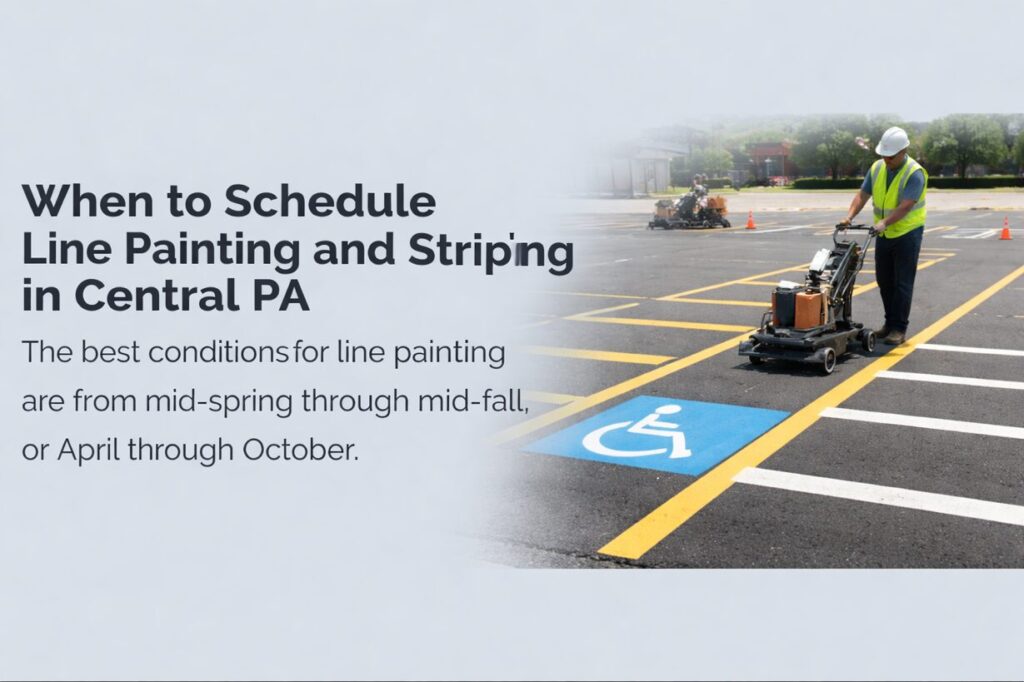
For commercial properties in Central PA, the optimal window for line painting and striping runs from April through October. This is when temperatures and surface conditions allow proper adhesion and curing.
Line painting requires one nonnegotiable — dry pavement. Moisture prevents paint from adhering properly, leading to premature fading and peeling. Beyond dry conditions, temperatures must remain above 40° Fahrenheit for water-based paints to dry quickly and bond correctly to the asphalt surface.
Line painting plays a key role in compliance and safety, not just in looks. Winter plowing can wear away the paint, especially in handicap parking spaces where ADA-compliant blue markings are required. Spring is the best time to check your lot for any damaged or faded striping that might lead to liability issues or code violations.
Annual line painting ensures clear traffic flow, properly designates parking spaces and maintains a professional appearance that reflects well on your business. For high-traffic commercial properties, touch-ups or full repainting every year keeps your lot safe, compliant and visually appealing.
Many property managers coordinate line painting with sealcoating during the summer months, creating a fresh, uniform appearance across the entire parking lot. However, a spring refresh in April or May offers advantages for retail properties, hotels and restaurants that want crisp, professional striping before their busy season. Effective seasonal parking lot planning ensures every service is performed when conditions deliver the best results.
Explore our line painting services for clear, durable markings that improve safety and organization.
When to Schedule Pavement Maintenance and Winter Preparation in Central PA
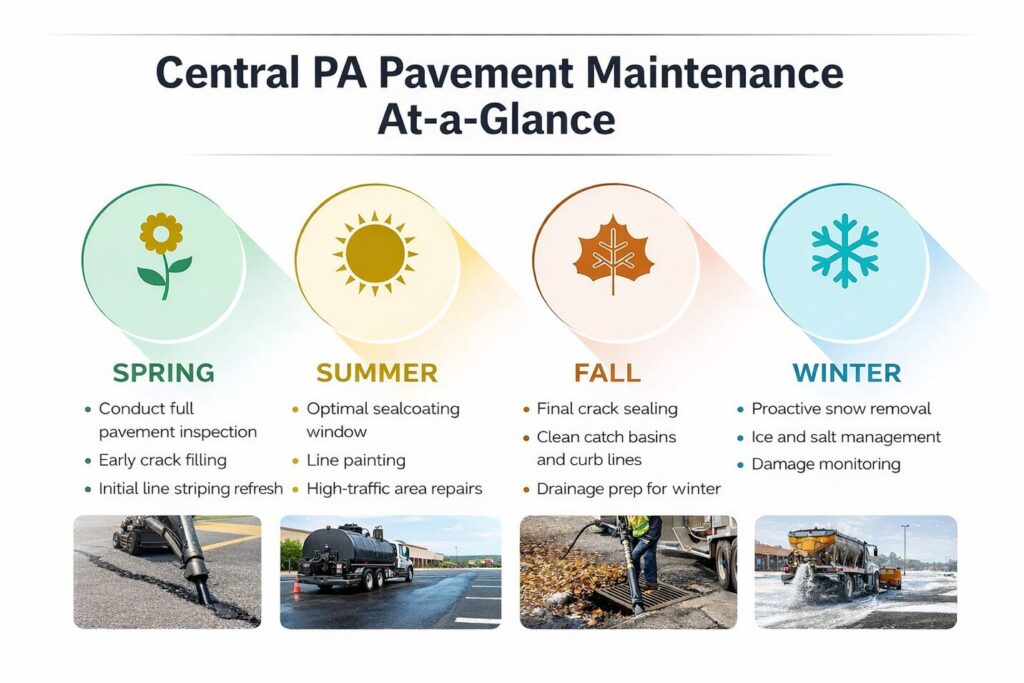
Sealcoating, crack filling and line painting have specific seasons when they can be done. However, general pavement maintenance requires ongoing attention year-round.
Fall Preparation
The Final Protection Window
Late fall represents the last reliable opportunity to complete preventative asphalt work before winter conditions set in. As temperatures begin to drop, property owners should focus on:
- Complete any remaining crack filling before sustained freezing temperatures arrive
- Clear catch basins, drains, and curb lines of leaves and debris
- Conduct a full pavement inspection to identify vulnerable areas
- Schedule services while the weather still permits proper material application
Standing water that freezes in clogged drains accelerates pavement deterioration and creates safety hazards.
Winter Execution
Controlling Freeze-Thaw Damage
During winter months, the goal shifts from preventative application to active asphalt protection. Prompt snow removal is critical. Snow that melts and refreezes repeatedly forces water deeper into cracks and joints. Each freeze-thaw cycle expands trapped moisture, gradually turning hairline cracks into major separations. Timely plowing reduces this exposure and limits structural stress.
Ice control strategy also matters. Choosing pavement-safe ice melt is important for pavement longevity. Daniel B. Krieg carries TruMelt from AgSalt Processing, which is pet-safe, plant-safe, paver-safe and concrete-safe. Avoid applying excessive salt directly to recently sealed asphalt when possible, as harsh deicing chemicals can break down protective sealcoat layers more quickly.
Winter is not when maintenance stops. It is when disciplined response protects the work already completed.
Spring Inspection
Identifying Damage Before It Escalates
Once the snow melts, conduct an immediate blacktop pavement inspection. Winter conditions often reveal new damage that wasn’t visible during the fall. Look for:
- Plow blade scraping and surface scarring
- Newly formed cracks or expansion of existing cracks
- Areas of base settlement creating low spots or standing water
- Drainage issues that developed during winter
Identifying these issues in early spring allows you to schedule pavement maintenance services before your busy season begins. It also prevents small problems from becoming expensive structural failures by summer’s end.
Explore our pavement maintenance services to extend pavement life and reduce long-term repair costs.
Partner With a Commercial Pavement Maintenance Specialist Serving Central PA
Following this Central PA seasonal calendar aligns your pavement maintenance services with the weather conditions that allow materials to cure properly and deliver lasting protection. Proactive planning based on these seasonal guidelines saves money, extends pavement life and maintains the professional appearance your property deserves.
Daniel B. Krieg has served Central PA commercial properties for over 90 years. Our team understands the regional climate challenges that affect pavement performance and knows exactly when conditions are right for sealcoating, crack filling and line painting. Whether you need service in the spring, summer, fall or winter, we’re ready to help you protect your pavement investment.
Contact us today to secure your spot on our seasonal maintenance schedule and start planning for lasting pavement performance.
The post The Optimal Commercial Pavement Maintenance Calendar for Central PA appeared first on Daniel B. Krieg.
]]>The post Complete Guide To Ice Melt Products in Harrisburg appeared first on Daniel B. Krieg.
]]>With the Harrisburg region’s cold, snowy winters, business owners need an actionable plan to manage icy buildup. It’s essential to choose the right product for winter ice management in Harrisburg, PA, and we’re here to guide you through the available options.
Understanding Different Types of Ice Melt Products
Selecting the correct type of ice melt for your Harrisburg property is essential. Different types of snow or ice-melting products perform best at different temperatures. Some are milder and may offer better results without impacting surfaces or the environment, while managing landscaped commercial spaces or businesses with animals requires the use of a plant and pet-friendly ice melt.
There are various types of ice melt on the market, each with unique properties and advantages.
Sodium Chloride
Sodium chloride, also known as rock salt, is one of the oldest forms of ice melt, and can provide traction when spread on icy surfaces. It is readily available, which means people often don’t realize there are several alternatives. The main challenge with rock salt is that it’s only effective at temperatures above 15° Fahrenheit.
Calcium Chloride
Calcium chloride is an ice melt that can function in frigid conditions, as low as minus 25° Fahrenheit, making it ideal for the coldest regions of the United States. However, it attracts moisture, which means it may exaggerate slippery floors when people unwittingly track it into the commercial building.
Pet-Safe and Environmentally Friendly Alternatives
Pet-safe ice melt, also known as plant-safe and environmentally safe ice melt, is an increasingly popular solution, with diverse options on the market. Some of the leading options, like TruMelt Halite, are effective in temperatures as low as 5° Fahrenheit — perfect for Pennsylvania’s cold yet moderate winters.
Magnesium chloride and calcium magnesium acetate (CMA) are two additional options in this category, both offering excellent results.
Selecting the Right Ice Melt for Your Specific Needs
When choosing an ice melt product for your winter management program, there are a few significant factors to consider. These include:
- Plant and animal exposure: For businesses dealing with plants and animals, like nurseries or pet stores, choosing a solution that will not harm plants or pets is essential. Certain snow melt products, like calcium chloride, can irritate animal paws and skin, making them an impractical option, so opt for a pet-friendly ice melt instead.
- Temperature range: Not all types of ice melt work in the same temperature range. Exothermic options generate their own heat and are best suited to truly frigid climates. Endothermic options absorb heat from their surroundings and work best in milder climates. Given Harrisburg’s lowest average temperature of 23° Fahrenheit, endothermic ice melt is sufficient.
- Corrosive effects: Some types of ice melt may have a corrosive impact on surfaces like concrete and pavement. Naturally, if you’re treating an asphalt parking lot or surface, you want to avoid deicing agents with these kinds of effects. Asphalt is better able to deal with these kinds of effects.
When you are looking for a solution that meets all these criteria and works well in Harrisburg’s mild winters, choose TruMelt Halite — it’s noncorrosive to asphalt and concrete, works in reasonably low temperatures and won’t negatively affect plants or animals.
Application Tips for Maximum Effectiveness and Surface Protection
Finding the right ice or snow melt solution is only part of the equation. To truly manage winter well, you also need to apply it at the right time and in the right way. Here are a few tips that may help:
- Apply the product as a thin, even layer, either by hand or by using a spreader.
- Salt surfaces before storms, or after shovelling, to prevent the ice from bonding to concrete or asphalt.
- Remove as much snow and slush as possible before every application.
Why Choose Daniel B. Krieg for Your Winter Maintenance Needs
Your snow and ice management regime is only as good as your choice in partners. Countless business owners choose Daniel B. Krieg because we offer:
- Extensive experience: With over 90 years of experience serving businesses in the Harrisburg region, we understand exactly what you need.
- Guaranteed stock: We specialize in managing winter conditions, which is why we always stock ice management supplies throughout the winter season.
- Expert advice: Our team of experienced professionals has the skills and knowledge you need to guide you through the available commercial ice melt supplies.
The Daniel B. Krieg team uses TruMelt Halite, a trusted, plant and pet-friendly solution to melt ice and snow, keeping your parking lots and driveways safe. When you partner with us, you know our products won’t compromise your pavement or concrete while protecting surfaces from winter weather. Rely on us for trusted services in the Harrisburg area.

Get Your Ice Melt Products Before the Next Storm
Don’t allow winter to catch you by surprise this season — invest in ice melt for better results. Rely on a trusted expert in the field to help you select the right product to encourage snow melt in Harrisburg. We’d be happy to guide you through the entire process for managing winter conditions like ice and snow. Contact Daniel B. Krieg today for TruMelt Halite.
The post Complete Guide To Ice Melt Products in Harrisburg appeared first on Daniel B. Krieg.
]]>The post Your Parking Lot’s Health Check: A Visual Guide to Common Pavement Distress Types appeared first on Daniel B. Krieg.
]]>A parking lot is the workhorse of any commercial property. It supports daily traffic, heavy loads and changing weather conditions. Over time, the surface begins to wear, and the warning signs can range from hairline cracks to full-scale potholes.
Recognizing early signs of pavement distress can mean the difference between a minor repair and a major paving reconstruction. To protect your asphalt investment, you first need to know what to look for.
Below are 10 common parking lot distress types, how to identify them and how they are typically repaired. If you have any questions, call the pavement maintenance experts at Daniel B. Krieg, Inc. today – we are here to help!
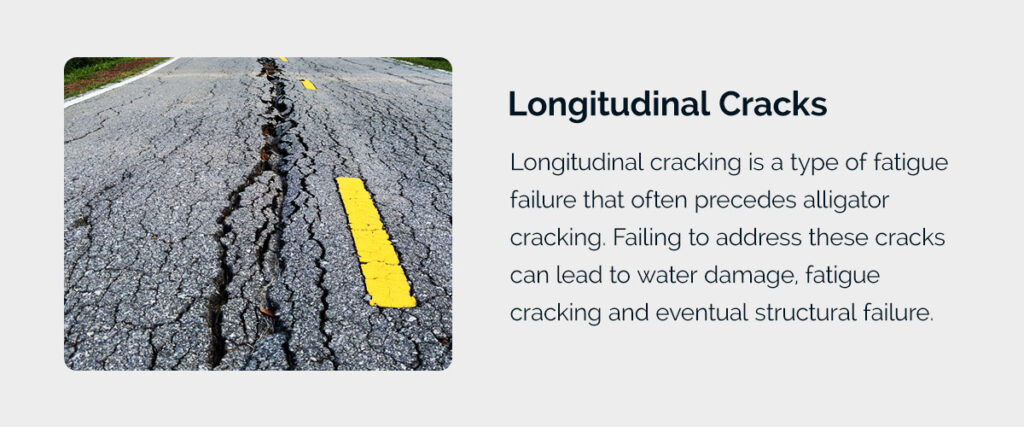
1. Longitudinal Cracks
Longitudinal cracking is a type of fatigue failure that often precedes alligator cracking. They run parallel to the laydown direction of the pavement. Failing to address these cracks can lead to water damage, alligator cracking and eventual structural failure.
Causes of Longitudinal Cracks
Possible causes of longitudinal cracking include:
- Joint issues: Poorly constructed joints or those that sit in the wheel path are more likely to fail.
- Sub or top layer cracks: A longitudinal crack can mirror damage in the sublayer. It can also crack from the top down.
- Fatigue: Like fatigue cracking, poor drainage, stripping or improper construction can cause these cracks.
How to Repair Longitudinal Cracks
Parking lot crack sealant is an effective repair for low-level distress. High-quality sealant, applied by experienced pavement maintenance professionals at Daniel B. Krieg Inc., ensures lasting and durable results. For severe damage, we remove the cracked asphalt and replace it with a new overlay.
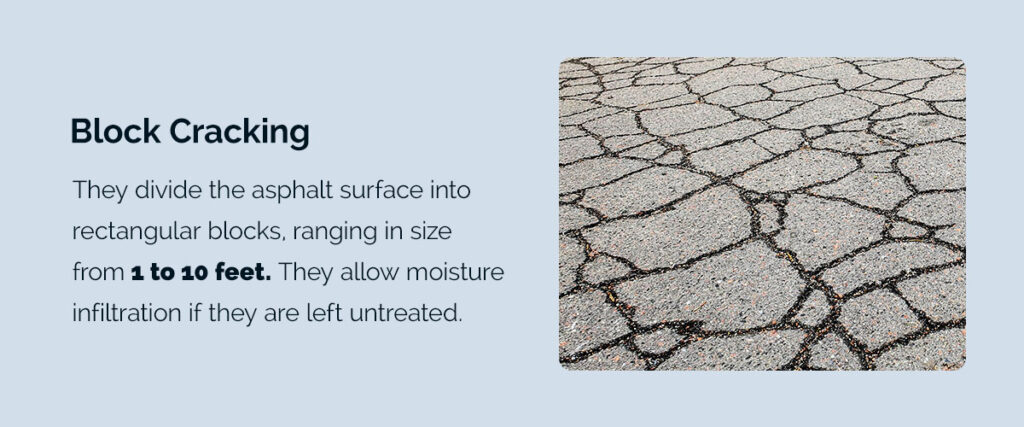
2. Block Cracking
Similar to alligator cracking, block cracking forms interconnected rectangular sections across the pavement surface, ranging in size from 1 to 10 feet.
The severity of block cracking is categorized as:
- Low: Unfilled cracks less than 3/8 inches wide or filled cracks where the sealant is in good condition.
- Medium: Nonfilled cracks between 3/8 inches and 3 inches wide with light surrounding cracking. Sealed cracks with surrounding light cracking.
- High: Sealed or nonsealed cracks with medium-to-high level surrounding cracks. Unfilled cracks wider than 3 inches or any size crack with 4 inches of surrounding broken pavement.
Causes of Block Cracks
Block cracking is typically caused by aging or inflexible asphalt binder. Asphalt binder is the insulating material that holds asphalt concrete aggregate together.
Asphalt expands and contracts with temperature changes. When binder loses flexibility, block cracking develops.
How to Repair Block Cracks
Minor block cracking can be sealed using rubberized joint and crack sealants by the pavement maintenance professionals at Daniel B. Krieg, Inc. Severe block cracking requires removing the damaged pavement and installing a new overlay.
3. Joint Reflection Cracking
Reflection cracks appear in asphalt overlays placed over concrete pavement and mirror the underlying concrete joints. This crack is commonly seen in rigid Portland cement concrete (PCC) pavement parking lots.
Causes of Reflection Cracks
Thermal or moisture-related movement of the concrete slab beneath the overlay causes this distress. The severity levels of reflection cracks are identical to block cracking.
How to Repair Reflection Cracks
Minor cracking can be sealed using rubberized joint and crack sealants by the experts at Daniel B. Krieg, Inc. Severe cracking requires removal of the damaged overlay and pavement replacement.
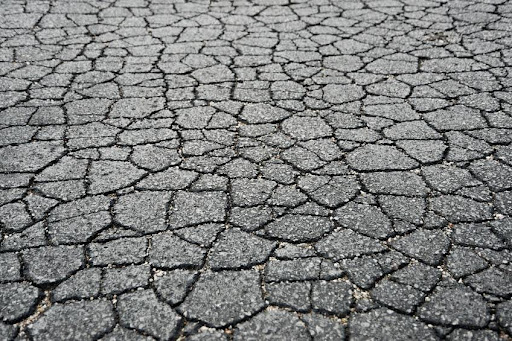
4. Alligator (Fatigue) Cracking
Alligator cracking occurs when asphalt is too thin or built on a weak subgrade. Heavy loads and repeated traffic cause interconnected cracks that resemble alligator scales, most commonly in wheel paths.
According to guides published by the U.S. Department of Transportation, crack severity can range from low to high:
- Low: Fine, hairline cracks have no breaking or chipping at the edges and are known as spalling. The cracks run parallel to each other with little or no interconnecting cracks.
- Medium: Medium alligator cracks consist of a network of light cracks with some spalling.
- High: This category means there are well-defined cracks with spalling at the edges that may move under traffic.
Causes of Alligator Cracks
Fatigue cracks have a few possible causes, including:
- Improper drainage: When water collects under asphalt, it can weaken the underlying materials.
- Stripping: The lower layers of asphalt disintegrate, which affects the upper surface.
- Excess loading: Heavier loads than planned during design can place stress on the paving.
- Poor construction: Asphalt that is too thin or not properly compacted during construction can fail.
How to Repair Alligator Cracks
Proper repair begins with identifying the cause, often through coring and moisture evaluation. Minor alligator cracking requires subgrade repair and drainage improvements, while severe alligator cracking requires full-depth repair or a high-strength asphalt overlay.
5. Bleeding
Bleeding appears as shiny patches of asphalt binder on the pavement surface. These areas can become slippery in wet conditions and sticky during hot weather.
Causes of Bleeding
Bleeding is typically caused by excessive asphalt binder in the mix or surface treatment.
How To Repair Bleeding
These repair methods can correct the surface issue but not the underlying problem:
- Low-to-medium bleeding: Blot up the asphalt binder using a layer of coarse sand.
- Severe bleeding: Remove the asphalt binder with the appropriate tools. You may need to resurface rough or uneven surfaces.
6. Corrugation and Shoving
Corrugation appears as ripples, while shoving forms wave-like ridges in the asphalt. These issues commonly occur in areas with frequent stopping, starting or where pavement pushes against fixed objects.
Causes of Corrugation and Shoving
Traffic movement combined with unstable asphalt or moisture in the subgrade causes this distress.
How to Repair Corrugation and Shoving
Minor and major damaged pavement must be removed. Smaller areas may be patched, while widespread damage requires an overlay.
7. Depression
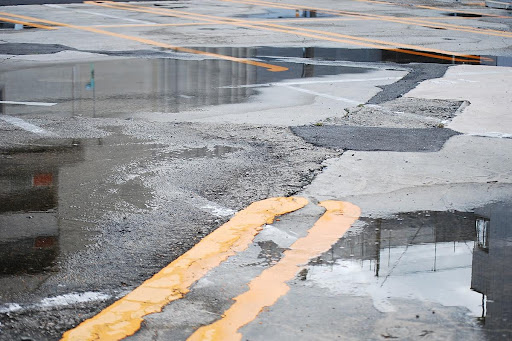
Depressions are sunken areas in the pavement that collect water, sometimes referred to as “bird baths.” Shallow depressions may only be visible after rainfall, while deeper ones increase hydroplaning risk.
The maximum depth of the depression informs the severity:
- Low: Between 1/2 an inch and 1 inch deep.
- Medium: Depressions that are 1 to 2 inches deep.
- High: A depth of 2 inches or more.
Causes and Repairs of Pavement Depression
Depressions typically result from poor construction or soil settlement. Repairs involve removing the affected pavement, correcting the subgrade and patching the surface.
8. Potholes
Potholes are bowl-shaped cavities with jagged edges that may extend to the pavement base. They commonly form in parking lots with thin asphalt surfaces and can cause vehicle damage. The severity of a pothole depends on its depth and diameter.
Potholes: Causes and Solutions
Potholes are often the final stage of fatigue cracking. Fixing a pothole has three possible solutions:
- Patching: This short-term solution involves shoveling asphalt into the hole and compacting it. Patching serves as a temporary measure before making permanent repairs.
- Mill patching: For superficial potholes, mill patching is a good option. It involves milling the area around the pothole and replacing it with compact asphalt.
- Dig-out patching: Deep potholes need a more lasting solution. Professionals dig out an area surrounding the hole, regrade the base and patch it with asphalt.
9. Raveling
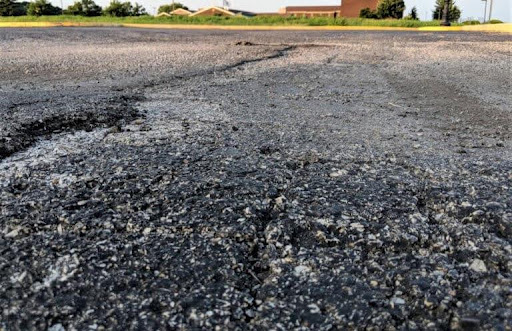
Raveling occurs when aggregate particles loosen and scatter, leaving a rough, deteriorated surface that increases skid and hydroplaning risks. Raveling severity ranges from coarse aggregate loss (medium) to significant surface pitting (high).
Causes of Raveling
Raveling results from the asphalt binder and aggregate bond weakening due to:
- Aging: When asphalt binder ages, it oxidizes and becomes stiffer, losing its bond with aggregate particles.
- Dust: The asphalt binder may bond with dust on the particles instead of with the aggregate.
- Missing particles: If the aggregate has too few particles, the binder has less to stick to.
- Improper compaction: The aggregate and binder need adequate compaction during construction to bond.
How to Repair Raveling
Minor raveling can be patched. Extensive raveling requires pavement removal and overlay installation.
10. Transverse Cracks
Transverse cracks run perpendicular to the pavement direction and follow the same severity scale as block and longitudinal cracking.
Causes of Transverse Cracks
Most transverse cracks are caused by thermal contraction, though binder hardening or reflective cracking may also contribute.
How To Repair Transverse Cracks
Low-severity cracks can be sealed by parking lot experts to prevent water intrusion. Severe cracking requires removal and replacement with an overlay.
The Importance of Proactive Parking Lot Maintenance
By the time pavement distress becomes obvious, damage may already be advanced. Small cracks can quickly evolve into potholes, creating safety hazards, vehicle damage and liability concerns. A neglected parking lot also leaves a poor impression on visitors.
A proactive pavement maintenance approach helps reduce long-term costs, extend pavement life and keep your parking lot safe and accessible.
Commercial Parking Lot Inspection Checklist
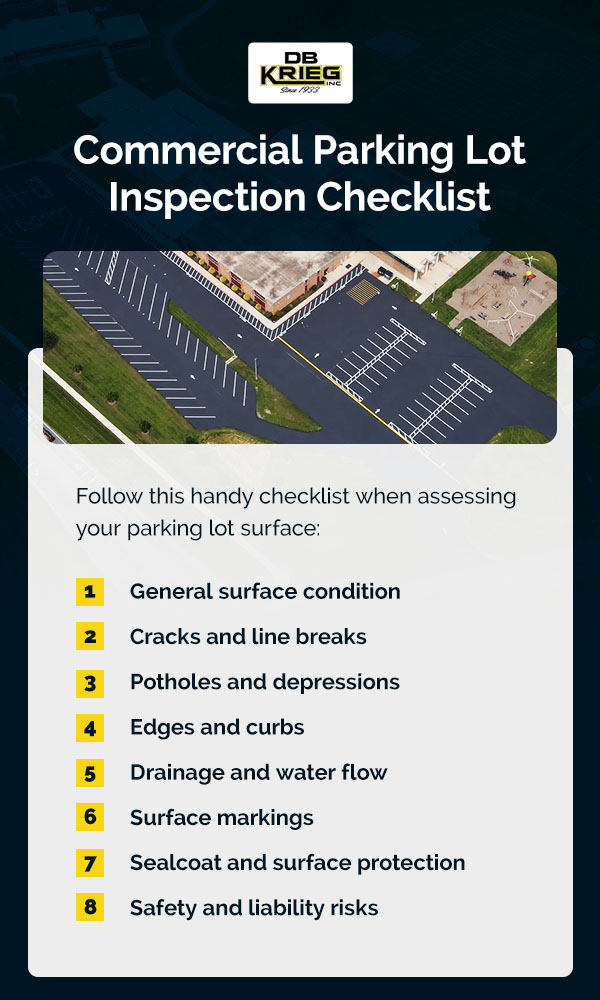
For property managers, regular inspections help catch potential asphalt pavement problems early. Follow this handy checklist when assessing your parking lot surface:
- General surface condition: Walk the entire lot and note areas that look uneven or worn. Look for changes in texture such as raveling, loose aggregate or cracking. Check for standing water after rain, as these areas often indicate grading or drainage problems.
- Cracks and line breaks: Identify the type of asphalt crack using this guide. Measure approximate widths and lengths, as this can help determine the severity of the damage.
- Potholes and depressions: Mark all potholes, regardless of size. Check for soft spots or areas that feel unstable underfoot.
- Edges and curbs: Inspect edges for crumbling or breaking and look for curb separation that signals possible water penetration.
- Drainage and water flow: Ensure drains, inlets and gutters are free from obstructions. Watch for erosion patterns or channeling caused by poor water flow. Confirm that water moves away from and not toward high-traffic spots.
- Surface markings: Check the condition of parking lines, directional arrows, ADA markings and loading zones.
- Sealcoat and surface protection: Assess the condition of any sealcoating. You should sealcoat your parking lot surface every three to five years or within three to six months of a new installation.
- Safety and liability risks: Look for tripping hazards, abrupt level changes or exposed materials. Note any areas with poor traction, damage or oil buildup.
Care for the Health of Your Parking Lot with Daniel B. Krieg
Our professional pavement maintenance services include crack filling and crack repair, sealcoating, asphalt rejuvenation, curb sealing, and line painting.
Since 1933, Daniel B. Krieg has cared for pavements across Pennsylvania. We offer a range of pavement maintenance services and products to keep your parking lot in top condition. From high-quality sealcoating services to reliable crack-filling services, our crews have decades of experience to ensure an exceptional result!
As industry leaders, we combine proven expertise with innovative methods and advanced equipment. We’ve earned the title of Top Commercial Sealcoating Contractor 11 years in a row!
Discover the better way to prevent parking lot distress. Contact us today to discuss your needs or to request a free estimate.
The post Your Parking Lot’s Health Check: A Visual Guide to Common Pavement Distress Types appeared first on Daniel B. Krieg.
]]>The post When To Sealcoat In Pennsylvania appeared first on Daniel B. Krieg.
]]>Whether you manage a convenience store, a bustling restaurant, an HOA community, or an entire shopping complex, keeping your parking lot and roadways in top condition is essential for safety, curb appeal, and long-term cost savings.
Sealcoating is one of the smartest investments you can make. It shields your asphalt from cracks and prevents damage caused by gasoline, oil, UV oxidation, water penetration, and harsh weather. But in Pennsylvania – where freeze-thaw cycles and dramatic temperature swings are part of the changing seasons – timing is everything. Applying sealcoat at the wrong time can drastically shortens its lifespan and wastes your money.
Discover the best season for sealcoating and pavement maintenance in Pennsylvania, plus proven strategies to maximize the life of your asphalt year-round.
The Best Time for Sealcoating in Central Pennsylvania
The best months for sealcoating in Pennsylvania are May through September. However, weather is the deciding factor – not the calendar. Sealcoating requires:
- Air and pavement temperatures staying above 50°F (ideally 70–90°F during the day)
- Low humidity (preferably under 70%)
- No rain for at least 24 hours after application
- Warm overnight lows (above 50°F)
These conditions are most common from late spring through early fall in Pennsylvania. Late May usually marks the start once overnight lows stabilize, and early September is typically the safe cutoff before fall rains and cooler nights arrive.
Avoid:
- Early spring (April/early May) — cold ground and frequent rain
- Late September and October — dropping temperatures and wet weather
- Extremely hot, humid days (95°F+ with high humidity) — can cause bubbling or poor curing
At Daniel B. Krieg, Inc., we are your trusted pavement maintenance experts serving Pennsylvania for over 90 years. Our experienced crews closely monitor weather patterns, track pavement temperatures, and only apply sealcoat when conditions are ideal — ensuring a durable, long-lasting finish every time.
Your Year-Round Seasonal Asphalt Planning Guide
Proper asphalt care requires planning across all seasons. A consistent annual strategy protects your investment and avoids rushed repairs.
Winter
Use the cold, wet months to plan ahead. Inspect your Pennsylvania parking lot or roadway pavement for cracks, potholes, and other signs of damage or distress. Document everything so you can budget and schedule repairs once weather improves. Look through your records and find out if your property has been sealcoated or crack filled within the past 4 years. If not – it is definitely due to be serviced. Crack filling is recommended on an annual basis in Pennsylvania, and sealcoating is recommended every 4-5 years.
Spring
Focus on preparation. Fill cracks, patch small potholes, and sweep the surface. Early spring is often still too cold and damp for sealcoating, so watch for “false spring” warm spells that aren’t reliable. Wait for consistent warmth before scheduling the actual sealcoat application. Spring is a great time for crack filling, in preparation for sealcoating application. At Daniel B. Krieg, Inc. our experienced crack filling crews fill over 3,000,000 LF of cracks annually for commercial property owners, PennDOT, and the Pennsylvania Turnpike.
Summer (Peak Season)
This is the best time for sealcoating in Pennsylvania. June through August typically offers warm, stable air and ground temperatures, plenty of sunlight, and low precipitation risk, and long days for curing. These conditions allow the sealcoat emulsion to set properly for maximum durability.
Fall
Early fall is your final safe window for sealcoating before nights turn cold. Act quickly—dropping temperatures and falling leaves, twigs, and debris can ruin a fresh coat. By late fall, shift to winter prep: re-inspect damage and plan next year’s budget. At Daniel B. Krieg, Inc. our team is ready to provide you with a free quote for your property’s budget next year.
Year-round planning keeps your asphalt in top shape, extends its life, and saves money in the long run.
Schedule Pavement Maintenance With Daniel B. Krieg
Your pavement is one of your property’s biggest investments—don’t let cracks, potholes, and weather damage erode its value and drain your budget.
Timely, professional crack filling and sealcoating stops deterioration in its tracks, dramatically extends the life of your asphalt, and saves you tens of thousands in premature repairs or full replacement.
When you choose Daniel B. Krieg, Inc., you’re partnering with a proven local leader that’s protected Pennsylvania pavement for decades with expert sealcoating services. We handle every detail with precision, keep you informed every step of the way, and deliver results you can see for years to come.
Ready to protect your investment and eliminate unnecessary expense? Call Daniel B. Krieg today or complete our online form for a free quote.
The post When To Sealcoat In Pennsylvania appeared first on Daniel B. Krieg.
]]>Your parking lot’s design and line striping layout directly impact its safety, functionality, and lifespan. At Daniel B. Krieg, we’re experts in commercial parking lot maintenance and offer professional crack filling, sealcoating, and line striping services to keep your lot in top condition. Proper maintenance and the right products can dramatically improve performance and extend your pavement’s life.
Schedule Parking Lot Maintenance
The Importance of Parking Lot Design and Layout
A well-designed commercial parking lot layout greatly improves your property’s layout, traffic flow, and efficiency. It enables easy navigation for drivers, staff, and guests, reducing congestion and frustration while boosting customer satisfaction and revenue for your commercial business or corporate office facility.
Essential Design Elements to Consider
Whether you have the idea of installing new pavement or modifying an existing parking lot, adhering to proven layout design standards is essential for safety, efficiency, and longevity. Below are the primary parts of a parking lot every project should address.
1. Parking Space Angles
Choosing from standard parking lot angles maximizes capacity while maintaining ease of use and safety:
- 90° (Perpendicular) Parking Most common and driver-friendly. Works best in industries with two-way traffic such as school parking lots or church car parking. Provides the widest spaces but uses more square footage per vehicle compared to angled parking.
- 45° Angled Parking Ideal for achieving higher parking density in two-way traffic zones while still being easy to enter and exit.
- 60° Angled Parking Preferred in one-way traffic configurations. This option requires wider aisles than 45° parking to maintain reversibility. This layout option allows more cars in the same space, increasing overall capacity.
- 0° (Parallel) Parking Typically reserved for municipal street parking or very narrow lots in a residential HOA parking area.
2. Traffic Flow and Circulation
Smooth, intuitive traffic movement prevents congestion and reduces accident risk for your facility. Standard Design Layout Principles:
- Separate entrances and exits whenever possible to avoid conflicts.
- Design clear one-way or two-way aisles based on the chosen parking angle.
- Provide adequate turning radii (minimum 24–28 ft for standard vehicles; larger for trucks or buses).
- Use highly visible pavement markings, directional arrows, and signage.
- Include speed control measures (speed bumps, narrowed lanes) in high-pedestrian areas.
3. Lot Drainage
Poor drainage leads to premature pavement failure, icing hazards, and liability issues. Best practices:
- Analyze site topography and local rainfall data during planning.
- Slope the entire lot a minimum of 1–2% toward drains (avoid flat areas).
- Install catch basins, trench drains, or slotted drains at low points and along slopes.
- Direct runoff to appropriate stormwater systems or retention areas.
- Schedule annual inspections and cleaning of all drainage structures to prevent clogs.
Additional Success Factors
Even the best parking lot design will underperform without:
- A professional, quality-focused initial installation using proper materials and compaction.
- A proactive maintenance program (sealcoating, crack filling, line painting, sweeping, and prompt repairs).
By addressing parking angles, traffic flow, and drainage from the start—and pairing them with high-quality construction and ongoing care—you’ll create a safe, efficient, and durable parking lot plan that serves your bank or financial institution needs for years to come.
How Parking Lot System Design, Installation and Maintenance Go Together
After your parking lot layout design is finalized and installed, trust Daniel B. Krieg for ongoing pavement maintenance and the products to keep your asphalt protected, no matter your parking lot size. We have been Pennsylvania’s “one-stop shop” for pavement maintenance products and services for over 90 years.
Pavement Marking & Measurement Products
Get precise spacing and markings with our high-quality marking and measuring tools. We stock measuring wheels, paints, stencils, chalk reels, and everything needed to execute your new parking lot design accurately. We also carry Graco’s full line of LineLazers and other line painting equipment.
Drainage Pipes
Proper drainage is essential for longevity and safety. At Daniel B. Krieg, we supply durable HDPE and galvanized steel drainage pipes built to withstand Pennsylvania weather.
Traffic Signs & Posts
Control traffic flow and ensure compliance with our high-quality traffic signs and posts. Our products meet Federal Highway Administration guidelines and other regulatory standards.
Sealcoating
Protect asphalt from cracks, fuel damage, and water damage with our premium-quality sealcoating services. Sealcoating restores asphalt’s appearance and extends your pavement’s life, which saves you money in the long run.
Crack Filling
Stop small cracks from becoming potholes with our professional crack filling services. Investing in annual asphalt crack filling maintenance is necessary in Pennsylvania, due to the freeze-thaw damage that occurs throughout the seasons. At Daniel B. Krieg, our crews fill over 3,000,000 LF of cracks annually for property owners, PennDOT, and the Pennsylvania Turnpike.
Extend Your Parking Lot’s Lifespan With Maintenance Services From Daniel B. Krieg
Your parking lot isn’t just pavement—it’s the first impression, the daily experience, and the silent backbone of your property’s success.
Partner with Daniel B. Krieg, the trusted name in parking lot and pavement maintenance for over 90 years, and keep your asphalt performing at its best, year after year.
Contact us today for a free quote!
The post Understanding Parking Lot Design: A Maintenance Expert’s Guide appeared first on Daniel B. Krieg.
]]>Sealcoating your property’s parking lot will protect your pavement and help you extend your asphalt’s lifespan. Sealcoating will also save you money by helping you avoid the need for costly asphalt repairs.
Understanding the average costs of commercial sealcoating projects in your area can help you determine whether you’re getting a fair deal.
How Much Does It Cost to Sealcoat a Parking Lot?
The average cost for sealcoating a commercial parking lot in Pennsylvania ranges between $0.13 to $0.30 per square foot, depending on the customer’s specific needs and other external factors. Some of the most important factors contributing to the total cost include the following:
- Labor
- Equipment
- Material costs (sealer, sand, and any additives required by the mix design)
- Logistics (some companies may charge more for “weekend” work when their laborers are in overtime)
- Necessary prep work (If a parking lot is very dirty and requires extra cleaning, the cost per square foot will be higher.)
- Mobilization costs
- Lot size
- If your job requires prevailing wages (schools, township and government buildings, etc.) the cost per square foot will be higher.
Most companies charge per square foot, which makes the price easy to estimate based on the size of your parking lot.
What Factors Affect Sealcoating Costs?
A general cost estimate for sealcoating projects should include these factors in the calculation:
- Lot size: Sealcoating retail parking lots may cost more overall. However, a property owner should be able to get a lower price per square foot for a larger parking lot or for sealcoating multiple residential properties part of an HOA, due to quantity.
- Asphalt condition: The condition of your parking lot determines how much prep the contractors will have to perform, which directly impacts the final project costs. Sealcoating municipal parking lots with extensive damage, such as potholes and large cracks, will cost significantly more than new, well-maintained lots. Dirty parking lots will also require more labor to properly clean the pavement, and the price per square foot will increase as a result.
- Labor costs: The more mobilizations your project requires will result in higher labor costs for the contractor.
- Economic factors: A sealcoating provider’s pricing may change based on economic factors like fluctuating material costs, geo-economic conditions, and more. Most quotes are good for 30 days from the date of the original quote.
- Materials used: While premium sealer products cost more than lower-end alternatives, they are worth the investment. These products typically include primer, sealer and paint, and they provide long-lasting results that will meet your specific needs.
- Number of coats: Higher-traffic areas require more coats of sealer than others, which raises the overall cost. Low-traffic areas may only need one coat of sealer, but the majority of parking lots with higher traffic, such as corporate offices, require two coats of sealer for the longest-lasting results.
Knowing the specific materials and techniques a service provider uses can help you understand their pricing. When one sealcoating contractor is more expensive than another contractor, it helps to ask them what materials they use, how experienced their workforce is, and how advanced their equipment is.
Sealcoating ROI: Why It’s Worth the Investment
While sealcoating can be a significant upfront investment for many organizations, it’s a project that can generate an excellent ROI.
Here’s how sealcoating your parking lot can benefit your business:
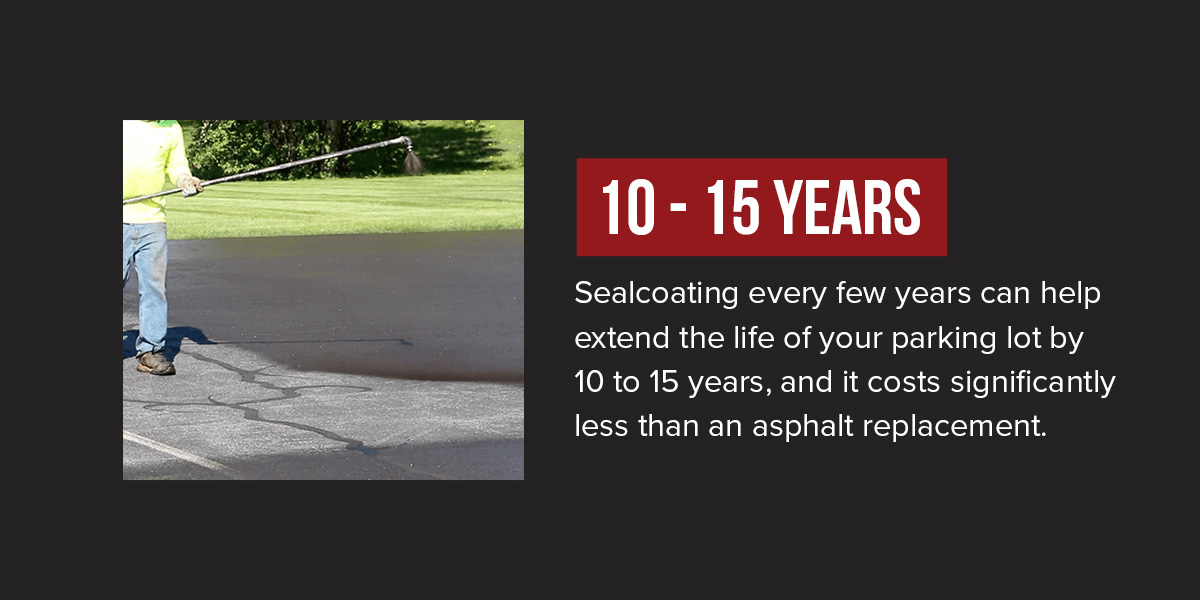
- Cost savings: Sealcoating every few years can help extend the life of your parking lot by 10 to 15 years, and it costs significantly less than an asphalt replacement.
- Enhanced appearance: When you sealcoat your parking lot, you refresh its appearance and improve the view customers have of your organization.
- Additional protection: A sealcoated asphalt surface is effectively protected against water penetration, surface oxidation and damage from harsh chemicals.
After the coating is applied, establishing a preventive maintenance routine can help you maximize your investment and ROI. Sealcoating is recommended every 4-5 years to keep your asphalt protected.
Budgeting Tips for Parking Lot Sealcoating
Sealcoating a parking lot is an investment, so carefully planning a budget is vital for a successful project. When you know the different contributors to the typical cost of sealcoating, you can figure out how it fits into your company’s budget.
1. Incorporate All Budgeting Factors
While getting a quote from your sealcoating provider will give you the most accurate estimate, you can get a general idea through basic calculations.
First, calculate the total square footage of your parking lot to determine how much space your coating provider will need to cover. Measure the length and width of the lot, then multiply them against each other. If there are any areas of the parking lot that extend beyond a basic rectangle, calculate those areas separately.
Once you calculate your square footage, multiply it by the average price per square foot to get your base estimate.
2. Schedule Regular Sealcoating Maintenance
While your parking lot may look immaculate, it’s best to reapply sealcoating once every four to five years to ensure lasting results. Establishing a preventive maintenance plan is one of the most effective ways to limit costs and prevent major damage to your parking lot.
Preventive maintenance inspections enable you to identify and address minor issues with your parking lot surface before they can escalate into costly repairs. For example, scheduling professional crack filling services between coatings can prevent small cracks from growing into severe issues like potholes.
Contact Daniel B. Krieg for Your Free Sealcoating Project Quote
Choosing the right service provider is critical for getting the high-quality treatment your parking lot deserves. At Daniel B. Krieg, we’re committed to providing the best possible customer experience in the industry for your commercial, public, or church property.
Many organizations and businesses trust our decades of experience and skilled professionals to provide excellent work on tight timelines, and we use only the highest-quality materials to ensure a lasting finish. We don’t cut corners — we find innovative ways to overcome jobsite challenges and deliver results.
Protect your school district’s parking lot through every season with our expert sealcoating. We also offer crack filling and line painting services. Contact us online or call our office at 800.334.4929 to request your free quote.
Contact Daniel B. Krieg For A Quote
Please contact Daniel B. Krieg, Inc. by filling out the form below, or by calling us at one of our locations.
The post Sealcoating Cost Planning Guide for Commercial Parking Lots appeared first on Daniel B. Krieg.
]]>Sealcoating your business’s parking lot pavement will renew the look of your asphalt with a fresh black coating. More importantly, sealcoating your asphalt will protect it by improving its resistance to environmental factors like water damage, UV rays, oxidation, fuel and chemical spills, and general traffic wear.
Contact Us for Sealcoating Materials
There is a range of materials that contractors use when they sealcoat. Each material has “pros and cons” when it comes to longevity, final appearance, the material’s components, and application methods. Every sealcoating project is unique, so it’s best that you have all the facts necessary to make an informed decision based on the advantages and limitations of each sealcoat material.
Keep in mind that every contractor will try to “sell you” on the specific material they use. The fact remains that every seal coat material has advantages and disadvantages, and it’s best to find a contractor that can educate you and recommend what is best for your specific needs.
3 Types of Pavement Sealers
The 2 primary types of pavement sealers used on commercial parking lots are coal tar sealers and asphalt emulsion sealers. Coal tar sealer has been around since the early 1960s, and it remains the prevalent material still used today. In the 1980s, asphalt emulsion sealers were developed as an alternative to coal tar sealers.
There is a 3rd type of pavement protective material called “asphalt rejuvenator”. Asphalt rejuvenator is different from sealcoat, because it penetrates the top layer of asphalt to help restore flexibility to the asphalt. In contrast, standard coal tar and asphalt emulsion sealers will simply coat the top layer of your asphalt.
Call Us for Sealcoating Materials
What Is Coal Tar Sealer?
Coal Tar sealer contains 20-35% coal tar pitch. It is a by-product of coking coal, which is a process used in the steel industry. Coal tar sealer also consists of water and emulsifying agents. The chemical compounds (over 5,000 of them!) in coal tar are stable in structure, resulting in a material with excellent waterproofing abilities and excellent resistance to oil, grease, and other petrochemicals.
Coal tar sealer is useful in places with high levels of traffic, such as commercial parking lots, schools, churches, airports, warehouses, factories, and more.
What Is Asphalt Emulsion Sealer?
Formed using emulsifying agents, water and asphalt bitumen, asphalt emulsion sealer is popular with contractors because they can apply it safely with minimal protective clothing (unlike coal tar, which requires contractors to wear long sleeves and face socks while applying).
Asphalt emulsion sealer cures quickly, is odorless and protects asphalt against water, oxidation and UV rays. Its fast curing process makes it a great choice for commercial properties with high-traffic parking lots that can’t be shut down for long. However, asphalt emulsion sealer does not typically last as long as coal tar sealer in high-traffic areas.
What Is Asphalt Rejuvenator?
While sealcoat materials will restore the dark look of your asphalt, their primary function is to protect the surface. An asphalt rejuvenator can be used to add another benefit: to restore the material’s original flexibility by penetrating down into the asphalt. Asphalt rejuvenators uses oils, polymers and resins to replace the oils lost over time and ultimately extend the asphalt’s life.
Even though asphalt rejuvenators are more expensive than coal tar and asphalt emulsions sealers, rejuvenators are becoming increasingly popular with schools, HOAs, airports, and commercial properties, as property owners seek to extend the life of their asphalt for as long as possible.
Coal Tar Sealer vs. Asphalt Emulsion Sealer
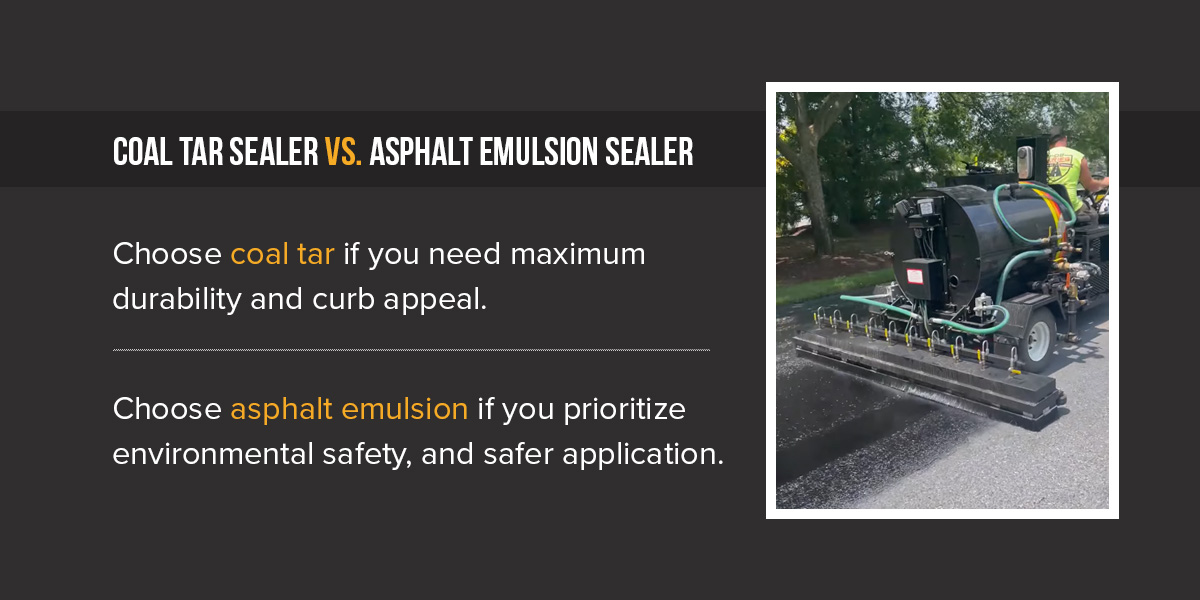
When comparing coal tar sealer vs. asphalt emulsion and deciding which is best for your needs, you need to consider the following aspects of each:
Durability and Longevity
The chemical structure of coal tar includes stable and strong aromatic hydrocarbons and compounds with a high molecular weight. This structure makes it harder for weather, high traffic and caustic substances like gasoline to break the molecules’ bonds, making coal tar sealer a durable, long-lasting option.
Due to asphalt emulsion’s different molecular weight distribution and less complex, lower concentration of aromatic hydrocarbons, it can be vulnerable to wear from gasoline, high traffic and harsh weather. However, with proper maintenance and application, an asphalt emulsion will perform well.
Appearance and Finish
When looking at color, texture and curb appeal, you’ll find that both coal tar sealers and asphalt emulsion sealers make the surface a nice, dark black color for sealcoating your school or bank parking lot. While the final color can vary slightly between the two sealers, both materials provide an attractive finished appearance.
Environmental Impact and Safety
Asphalt emulsion has an advantage over coal tar when it comes to public opinion regarding environmental impact. The component that makes coal tar so strong and durable, polycyclic aromatic hydrocarbons (PAHs), is made of organic compounds that give off an initial odor that some argue is bad for our health. It is important to note that opinions vary widely when it comes to this topic, especially for municipal applications.
Call Us for Sealcoating Materials
Application and Maintenance Considerations
Each sealer requires the same three steps:
- Surface preparation: Pavement should be cleaned thoroughly to prep the area. Ideally, pavement should be cleaned with turbine blowers, rotary brooms and sweepers.
- Application: Squeegees or specialized spray equipment will apply two coats of sealcoat material.
- Curing: Coal tar and asphalt emulsion sealers can take anywhere from 12-24 hours to dry, before traffic can drive on the asphalt again. While asphalt emulsions sometimes dries faster than coal tar, drying time depends heavily on the weather, temperature, and humidity levels.
In terms of maintenance needs, asphalt emulsion will need more regular resealing, generally every two to four years. Coal tar can be resealed every three to five years, so you’ll need to consider the frequency of resealing when making a decision for sealcoating your office parking lot.
Limitations of Each Sealer
Each sealer has limitations that you should consider before making your choice:
What Are the Disadvantages of Asphalt Emulsion?
Asphalt emulsions do not last quite as long as coal tar in high-traffic areas such as churches or sealcoating residential HOA communities.
What Are the Disadvantages of Coal Tar?
Some companies consider coal tar more difficult to apply, since the applicator needs to wear more protective equipment during application. You’ll want to choose a company that uses high-quality coal tar products and follows proper application procedures. Both coal tar and asphalt emulsion products can be excellent options, but their effectiveness depends on proper manufacturing, mixing, and application.
How Daniel B. Krieg Can Help
There is much to consider when choosing the right sealant for your commercial asphalt area. However, you don’t have to do it alone. At Daniel B. Krieg, we offer expert consultation and help selecting the right sealer for your needs.
Contact us today for a consultation for personalized recommendations and award-winning service.
The post Sealcoating Materials Guide appeared first on Daniel B. Krieg.
]]>The post Parking Lot Maintenance Guide appeared first on Daniel B. Krieg.
]]>Your parking lot is the first thing that visitors see when they come to your property. A parking lot that shows signs of neglect will have a negative impact on your visitors before they even reach your front door.
Beyond first impressions, asphalt parking lot maintenance is also a crucial part of your safety plan. You could hurt your customers and leave yourself wide open for financial liability by neglecting your parking lot asphalt. This is because unrepaired cracks and potholes are menaces for cars and potential tripping hazards for people.

Immediately after having your parking lot asphalt installed, you should start planning your maintenance program. A Daniel B. Krieg professional can set you up with a cost-effective pavement maintenance plan for your parking lot to keep your asphalt in good condition and save you money in the long run. We typically recommend crack filing annually and sealcoating every 3-5 years. Based on the size and condition of your parking lot, our parking lot contractors can even provide you with budgetary numbers to help you plan ahead.
Call Us for our Parking Lot Maintenance
Why Pavement Maintenance Plans Are Important
Crack filling and sealcoating your asphalt parking lot pavement is much less expensive than having to repair and/or replace it as a result of neglect. Parking lots that are sealcoated every three to five years and crack filled annually can last 30 years without replacement, compared to an approximate 15-year lifespan for a lot with little to no maintenance.
Sealcoating can cost as little as 8 cents a square foot, compared to as much as $6 a square foot for major asphalt repairs. We estimate that routine crack filling and sealcoating services can save a business as much as $120,000 on a 30,000-square-foot parking lot over its full lifetime.
Some additional reasons why parking lot maintenance plans are critical include:
- It enhances curb appeal: If you have a commercial business that depends on high customer volume, you understand the importance of a visually appealing parking lot and landscape. Besides crack filling and sealcoating, signage and other accessories can improve your parking area’s appearance. An aesthetically pleasing outdoor space can go a long way in developing a positive reputation.
- It increases safety: Pavements subject to neglect can quickly develop potholes and cracks while also accumulating unwanted dirt and debris. Besides causing damage to vehicles, holes in your parking lot can put your customers at risk of injury. Pools and puddles of water can also pose similar risks.
- It optimizes parking efficiency: Overexposed pavements and lots usually have unclear or faded lines indicating the correct parking spot locations, which can cause confusion. Or, if your pavement has potholes, people will avoid those spots because of the potential damage. Having inadequate parking could cause your customers to take their business elsewhere.
- It reduces liability: Potholes and cracks in your pavement create higher risks during the winter months. These holes are susceptible to becoming icy spots, making your parking lot potentially more dangerous to pedestrians. You may be subject to a lawsuit if a severe injury occurs because of a poorly maintained parking lot or another paved area on your property.
- It improves accessibility: Laws like the American Disabilities Act require specific markings and a certain number of parking spaces to provide adequate accessibility. Faded lines and markings could ultimately become a violation of the law if they remain untreated. You must also maintain curbs, ramps and slopes to comply with these regulations.
Contact us today for a free quote to take your first step to a better parking lot asphalt maintenance plan.
How Asphalt Deteriorates
Asphalt is constantly bombarded with UV rays, water and — in most of the country — expanding and contracting ice during the winter months. Over time, the combined attacks of water, oxidation and thermal fluctuation cause the asphalt surface to dry, grow brittle and break down. Tiny cracks form in the dried surface, which loosen the aggregate and let water in. Oil leaks from cars often accelerate this deterioration.
Without regular crack filing and sealcoating maintenance, what is left after a few years is a dry, gray surface riddled with cracks and potholes. This is one reason why having an effective parking lot asphalt maintenance plan is crucial for keeping a compliant and safe parking lot.
How to Maintain Your Parking Lot Asphalt
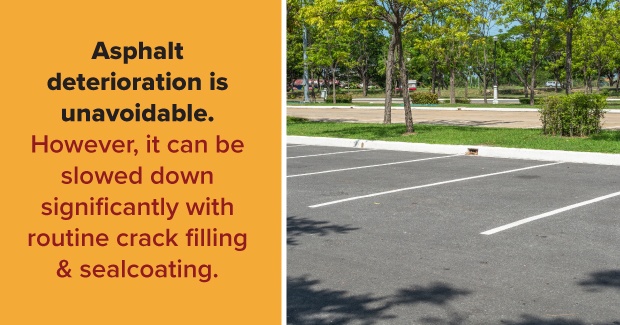
Unfortunately, asphalt deterioration is unavoidable. However, it can be slowed down significantly with routine crack filling & sealcoating. Don’t make the mistake of neglecting your asphalt – you will be saving yourself significant money in the long run by giving your parking lot the care & attention it needs.
It’s a good idea to walk your parking lot every few months to assess its current condition. A Daniel B. Krieg professional can help you with this. Our estimators can assess the current condition of your parking lot pavement and provide you with our most cost-effective recommendations, as well as a free, no obligation quote.
Some additional tips for parking area maintenance include:
- Sweeping: Keeping your parking lot clean with frequent sweeping can prevent dirt, dust and debris from creating cracks. Cleaning also enhances your property’s curb appeal.
- Snow removal: Prompt snow and ice removal are critical because ice poses a considerable threat to your parking lot’s surface and the vehicles on it. Working with a reputable plowing service during the winter is highly beneficial.
- Proper drainage: Having suitable drainage systems in place is essential because pools of sitting water are among the most serious threats to an asphalt surface.
- Restricted heavy vehicle access: Preventing vehicles over a certain weight from parking on your property can go a long way in protecting your asphalt. If possible, limit their parking times or require them to park only in designated areas.
How Often to Sealcoat and Crack Fill a Parking Lot for Best Maintenance
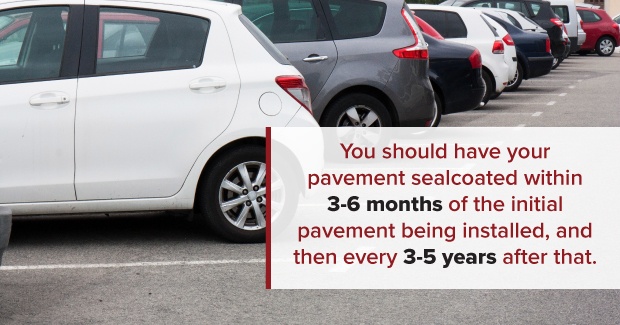
If your pavement appears coarse, dry and gray, then it is due for a sealcoat. You should have your pavement sealcoated within 3-6 months of the initial pavement being installed, and then every 3-5 years after that. Sealcoating protects pavement against water penetration, oxidation and oil leaks. A freshly sealcoated surface will also restore the clean, jet-black look of a newly installed asphalt parking lot. At Daniel B. Krieg we use only the best materials. Our sealer is a durable, high-performance, environmentally friendly material that is backed by a nationally recognized quality assurance program. Contact us today for a free quote.
If you notice cracks in your pavement that are 1/8” or wider, they should be crack filled immediately to prevent them from growing and expanding. A large crack can generate migrating cracks, which will eventually result in failure of your pavement sub-base (i.e. potholes, raveling, alligatoring, etc.) Once your pavement sub-base fails, you will have no choice but to pay for an expensive replacement service. At Daniel B. Krieg, we use high-pressure air to clean cracks, followed by an application of rubberized sealant.
If your lot is in Harrisburg, York, Mechanicsburg, Camp Hill, Carlisle, Lancaster, Hershey or surrounding areas, call or submit an online request for a free quote and get started on an effective preventative maintenance plan for your asphalt parking lot.
Contact Daniel B. Krieg For A Quote
Please contact Daniel B. Krieg, Inc. by filling out the form below, or by calling us at one of our locations.
The post Parking Lot Maintenance Guide appeared first on Daniel B. Krieg.
]]>The post Commercial Asphalt Maintenance Glossary appeared first on Daniel B. Krieg.
]]>Good property owners know that regular, comprehensive asphalt maintenance is important. Hiring a reliable pavement maintenance contractor that can crack fill, joint seal, tack coat, and sealcoat will take a significant “maintenance worry” off of your list. As a leading pavement maintenance contractor in the Harrisburg and central Pennsylvania region, we pride ourselves on not only completing every project to exceptional standards, but also on educating our customers about the best way to keep their pavement properly maintained throughout the years. This includes an understanding of pavement terminology.
Why You Should Understand Asphalt Terminology
Asphalt and parking lot terminology may be a little confusing at first, especially for property owners who might be new to parking lot maintenance. To the untrained eye, any cracking on the pavement may be as indistinguishable as the next. However, a property owner who can tell the difference between block cracking, transverse cracking, reflection cracking, slippage cracking, longitudinal cracking, and fatigue cracking will understand why it’s happening and how it needs to be fixed.
Knowing how to define different types of asphalt cracking, along with some basic knowledge about the materials and equipment that contractors use to repair pavement, will allow a property manager to take the proper first steps to maintain their asphalt. Knowing these terms, listed below, can also help a property manager describe the issues they are seeing to a pavement maintenance contractor they are looking to hire.
Asphalt Maintenance Terms
Here are some asphalt maintenance and paving terms, in alphabetical order.
Alligator Cracking
Alligator cracking, also known as fatigue cracking, looks “scaly” like an alligator’s skin. Alligator cracking results from load-related deterioration. Some common causes of alligator or fatigue cracking include overloaded vehicles, thin pavement or a weakened subgrade or base course. Light alligator cracking can be overlayed with new asphalt. Severe alligator cracking will need to be removed and replaced with new pavement.
Asphalt Binder
Asphalt binder is also known as asphalt cement or asphalt cement binder. Asphalt binder combined with asphalt aggregate makes a flexible pavement.
Asphalt Overlay
Asphalt overlaying is a resurfacing practice in which a new layer of asphalt is added on top of an existing layer of asphalt. Depending on the condition and needs of the surface, overlaying on the pavement can be a more cost-effective and quick solution for increasing strength without committing to an expensive and time-consuming method of completely removing and repaving the existing asphalt.
Asphalt Sealing Additives
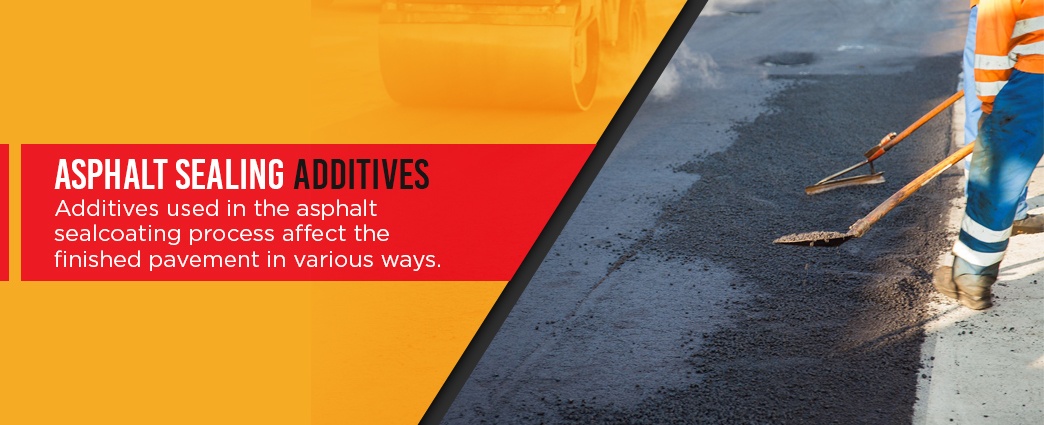
Additives used in the asphalt sealcoating process affect the finished pavement in various ways. Some additives provide extra strength while others help the pavement resist water, oil, gas or other potentially harmful materials.
Backer Rod
An asphalt crack backer rod is a not a rod at all, but rather, a material that partially fills small asphalt imperfections. These materials are either foam or polyethylene and enhance the effectiveness of the crack sealants.
Base
The base is a catchall term that describes any material used as a strong foundation for the asphalt. Bases vary in their levels of thickness, with a thicker base able to sustain an increased weight. Although a base can use many different types of materials including crushed stone and upcycled pavement, the correct base needs to be applied at the correct level of thickness to ensure that the asphalt in question doesn’t fail.
Base Failure
When the base thickness or material can’t accommodate the needs of the surface, the base will fail. Weight is a significant influence of failure but groundwater and improper installation can also contribute to base failure.
Berm
A berm refers to a raised surface strip alongside a path or near a body of water. When used in relation to asphalt, it refers to the raised strips of asphalt that act like or replace a curb on either side of the road.
Block Cracking
Block cracking occurs when large sections of interconnecting asphalt cracks create a shape similar to a rectangle. Although these cracks usually cover a large section of pavement, potentially stretching multiple feet, block cracking isn’t caused by load issues. When asphalt binder is unable to expand or contract with heat levels, it will shrink, resulting in block cracking.
Bollard
A traffic bollard, or simply a bollard, is a vertical post installed on a paved surface to control and direct both vehicular and pedestrian movement. Bollards can be temporary or permanent. They often block off areas in which vehicles are not permitted or where only authorized vehicles may enter.
Cold Patch
Cold patches are also known as cold mixes or cold asphalt because the asphalt mix does not need to be heated prior to installation. Cold patch material can be used to fill potholes as a temporary fix.
Compaction
Compaction is the process in which each individual layer of asphalt is reduced to a smaller volume to increase density.
Complete Reconstruction
The complete reconstruction of a surface involves removing and replacing all of the asphalt down to the base. This occurs typically when the pavement is at its last stages of life.
Crack Filler
Crack filling is the #1 most cost-effective way to protect asphalt. The crack filler material reinforces the pavement surrounding the cracks and prevents water from penetrating the cracks. Using crack filler can increase the safety, appearance and strength of asphalt substantially.
Crack Sealing
Crack sealing is the process of applying a crack sealant to an area of asphalt.
Call Us for our Resealing Service
Depressions
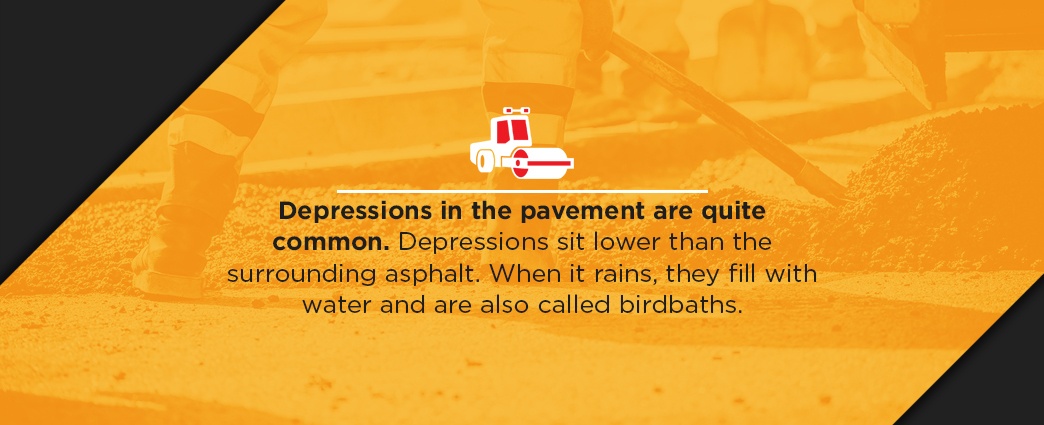
Depressions in pavement are quite common. Depressions sit lower than the surrounding asphalt. When it rains, they fill with water and are also called birdbaths. Some light depressions can be fixed via infrared or surfacing patching while severe depressions will likely need to be removed and replaced.
Edge Cracking
Edge cracks are longitudinal cracks that occur within two feet from the edge of the asphalt surface that is next to an unpaved surface. These cracks are signs that the edge of the asphalt lacks support.
Heated Asphalt Distributor
TThe heated asphalt distributor is a versatile truck that can perform a variety of functions. Asphalt distributor trucks are primarily used to spray emulsion materials via a spray bar on the rear of the truck. Using computerized rate control, the truck is able to provide a consistent rate of material application across the surface area.
Heated Hose
A heated hose is the device used to apply a number of different liquid asphalt materials, such as crack sealant.
Infrared Repair
Infrared asphalt repair is a method of surface repair. An infrared machine radiates heat onto the pavement to soften it up. The new asphalt mix is then added and the entire area is compacted.
Longitudinal Cracking
Longitudinal cracking is a form of cracking that is present near the centerline of the paved surface. The cracks can be caused by poor workmanship, shrinkage and reflecting cracks, but do not occur due to load issues.
Oil Spot Primer
An oil spot primer is a product that is applied to patches of oil or grease prior to sealcoating, to ensure that the sealcoat material properly adheres to the pavement. These primers also prevent oils and fuels from bleeding through the seal coat down into the lower layers of a pavement surface.
Patch Paving
Unlike pothole patching, patch paving is a method of pavement repair that removes the full surface layer — and sometimes the base material — then replaces it with new asphalt. It is done to replace severely damaged asphalt, especially surfaces that have endured years of heavy traffic and weather exposure.
Paving Fabrics
Paving fabrics are installed to absorb stress, resist moisture, reduce reflection cracking and increase the life of pavement. These fabrics are made from millable, recyclable materials that are then covered by treatments or overlays.
Reflection Cracking
Reflection cracking is caused not by what happens on the surface of a pavement, but rather, what happens to the underlying asphalt layers. When these layers move due to stress or movement, they create cracks on the surface that mirror that patterns on the base.
Rutting
Rutting is a type of asphalt distortion that occurs on the wheel path of a roadway or parking lot. These vertical or linear surface depressions are caused by problems in the layers of asphalt such as poor compaction, inadequate thickness or inefficient asphalt mixtures.
Call Us for our Resealing Service
Sealcoating
Sealcoating is a practice that will extend the life of your pavement by reducing the opportunities for wear and tear that normally occur. The sealcoating process involves applying a protective coating material over pavement that protects against oil, water and ultraviolet radiation.
Slippage Cracks
Slippage cracks occur when the bond that binds the surface of the asphalt with the layers beneath it breaks down. Dust, oil and dirt can cause this to happen over time.
Shoving
The ripples that form across a stretch of pavement via horizontal stress is known as shoving.
Spalling
Spalling is a term that refers to damages occurring at the edges of a paved surface. It includes asphalt chips, breakage, cracking and fraying. Spalling is considered a significant problem because it has the potential to spread under increased stress.
Transverse Cracking
Another common form of asphalt cracking, transverse cracking appears perpendicular to the pavement’s centerline. Unlike some other forms of cracking, transverse cracks aren’t caused by load-bearing problems. Rather, they are caused either by shrinkage of an asphalt layer or from the reflection of an existing asphalt crack.
Upheaval
Upheaval is a type of asphalt depression in which the pavement moves upward via subgrade swelling.
Vibratory Roller
Vibratory rollers are used to compact paving materials. These machines feature two tandem steel drums that vibrate to compact roller-compacted concrete and asphalt mixes. More advanced vibratory rollers are equipped with software that can measure compaction degree and create detailed compaction values for the entire project site.
DB Krieg — Your Pavement Maintenance Specialists
There are a lot of asphalt maintenance terms, and while this isn’t a fully comprehensive list of all pavement terminology, the terms above are ones you’re likely to hear when maintaining your parking lot. Over time, you’ll learn how to spot the unique signs of different types of asphalt damage and get them taken care of before your parking lot or roadway inconveniences your customers or damages passing vehicles. By simply crack filling and sealcoating your pavement every 3-4 years, you can double the life of your asphalt and save significant money in the long-run.
Do you need help preserving your asphalt lot? We’ve been proudly crack filling and sealcoating pavement throughout Central Pennsylvania for nearly a century. Named a Top Sealcoating Contractor for eight consecutive years by Pavement Maintenance & Reconstruction Magazine, DB Krieg is the premier asphalt maintenance company that businesses rely on for the best products and services in the Harrisburg area. From family-owned businesses to PennDOT and the Pennsylvania Turnpike, we can handle any size job.
We’re also pleased to offer highway services including tack coating, prime coating, joint sealing, and more. Do you need pavement maintenance or highway safety products for your next job site? Browse our selection of traffic signs, posts, personal protection and safety equipment, drainage pipes, geotextiles, and much more. Learn more about all our high-quality products and contact us today to discover how we can help you preserve and maintain your pavement for years to come.
Contact Daniel B. Krieg For A Quote
Please contact Daniel B. Krieg, Inc. by filling out the form below, or by calling us at one of our locations.
The post Commercial Asphalt Maintenance Glossary appeared first on Daniel B. Krieg.
]]>