
For every 4 billion vehicle-miles of travel in the United States, there is a work zone fatality. These incidents account for 10% of roadway congestion and 24% of roadway delays — and hundreds of worker and pedestrian fatalities each year. The Bureau of Labor Statistics (BLS) cites transportation incidents as the most frequent type of work-related fatalities. In fact, they caused 40% of all reported work fatalities in 2018. That’s the highest number of fatal work incidents in the U.S., making the construction industry — especially those working alongside highways — one of the most dangerous fields in the U.S.
Call Us for Traffic Safety Equipment
The construction industry recognizes the “fatal four” accident types, which result in the majority of all work-related injuries and fatalities. These common hazards include:
How do we keep construction workers safe along highways? By minimizing construction hazards and taking steps to promote road construction safety. Everyone has a role to play in construction work zone safety, including pedestrians, crew members and site managers. Each person must practice safety-first habits and remain vigilant of their surroundings.
According to the National Work Zone Safety Information Clearinghouse, there has been a steady rise in fatal crashes and work zone fatalities in the U.S. since 2009. In 2018, there were 755 total fatalities, with 672 of those involving crashes. Of those fatalities, 124 were construction workers.
Between 2011 and 2016, the following events led to fatal highway construction injuries:
As you can see, pedestrian vehicular incidents were the leading cause of highway construction injuries, causing more than half of those reported in the five-year period. Of those pedestrian vehicular incidents:
The U.S. Department of Transportation Federal Highway Association (FWHA) lists large trucks and buses as the leading vehicles involved in worker fatalities, though pickup trucks, semis and tractor-trailers, SUVs, vans and equipment vehicles also pose a threat. Speeding was a factor in a significant number of work zone crashes. The majority of these incidents occur on arterial roads, followed by interstates.
One of the most significant non-vehicular causes of on-road and off-road worker injury is crystalline silica dust. Silica dust forms from crushed rock, sand and concrete, and frequent inhalation may cause lung disease, lung cancer, chronic obstructive pulmonary disease (COPD) or kidney disease. These illnesses can result in disability, sickness or death. OSHA reports that nearly 2.3 million workers are exposed to silica on the job site. They have compiled a database with specific instructions for preventing silica dust and protecting workers, depending on the source of the dust and what machinery is producing it.
Daniel B. Krieg is committed to worker safety, which includes ensuring you have the highest quality products to keep employees safe and healthy.
The Occupational Safety and Health Administration (OSHA) developed standards to improve workplace safety and health. In 2016, they renewed their alliance to keep roadway construction workers safe from run-over and back-over hazards, damaging noise, sprains, strains and silica-related illness. Part 1926 addresses safety concerns for construction sites, specifically the use of danger signs, caution signs, exit signs, directional signs and traffic signs. The following requirements are only a few examples:
Part VI of the Manual on Uniform Traffic Control Devices, issued by the FHWA, provides additional guidance on standards for traffic signs, road surface markings and signals. Section 6D.03 requires the use of high-visibility safety apparel working on federal highways, citing the high degree of vulnerability that workers and responders face near roadways and acknowledging the need for efficient completion of road projects. They also support the usage of temporary traffic barriers, worker safety planning, adequate training for all workers and enforced speed reduction.
The National Institute for Occupational Safety and Health (NIOSH) Construction Equipment Visibility webpage provides guidance on preventing back-over injuries and fatalities while advising on proper equipment operation and servicing. This includes identifying blind areas around work zones for increased visibility. NIOSH has led the effort in reducing the number of workers struck by road construction equipment.
The American National Standards Institute (ANSI) provides standards for high visibility safety apparel and headwear, specifically through ANSI 107-2010. ANSI A10.47-2020 provides guidance on flagger safety, run-over and back-over prevention, equipment operator safety and personal protective equipment. In 2020, ANSI updated standards to include disposable high-visibility coveralls, adjustments to bursting strength standards for knitted materials and an emphasis placed on overall luminance in garments for additional visibility at the work site.
The National Highway Work Zone Safety Program (NHWZSP) also works to enhance the safety of highway work zones for motorists and highway workers alike. The NHWZSP provides standardization of traffic control devices and traffic control plans in addition to work site evaluation. The NHWZSP also introduces innovative technologies to improve safety.
National Work Zone Awareness week, which usually takes place in April each year, is a joint effort by the American Traffic Safety Services Association (ATSSA), the American Association of State Highway and Transportation Officials (AASHTO) and the FHWA. It’s a multi-day outreach event that focuses on raising public awareness surrounding work zone risks and safety precautions.
It’s important that work site safety plans consider the above standards and guidelines. All safety plans should include hazard assessments to identify risks and outline provides to mitigate them.
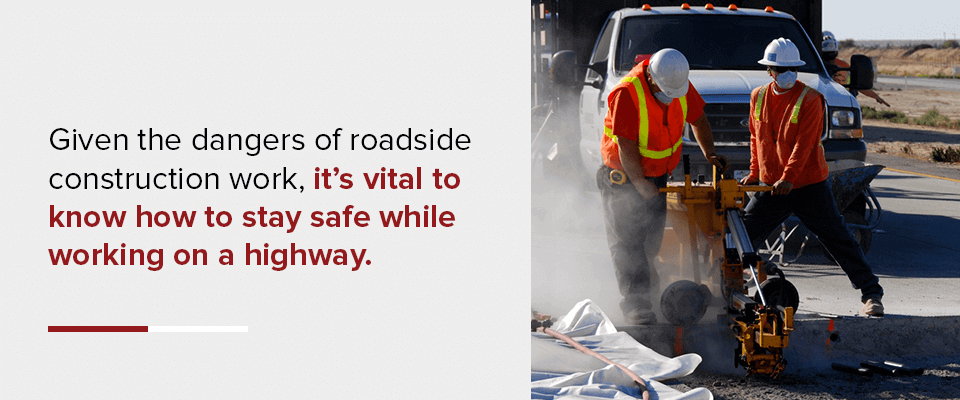
Given the dangers of roadside construction work, it’s vital to know how to stay safe while working on a highway. Consider the following safety tips to protect yourself from work zone injuries:
Flaggers should keep enough distance from other highway workers to ensure they can be distinguished by passing motorists. They should also use good sight communication or two-way radios to communicate with fellow flaggers. This will minimize risk on highway work sites.
All workers should be careful not to assume they can be seen by equipment operators or motorists. You’ll need to make sure that motorists slow down and equipment operators acknowledge your presence.
If you’re supervising or managing a highway construction project, consider the following tips on how to keep highway workers safe with administrative controls:
Once you’ve done everything in your power to enforce safety in road construction work zones, you must continue to monitor and adapt the work site until the project is finished. Weather, traffic flow patterns, crew changes and equipment failure are commonplace at highway jobs, and they can cause a chain reaction of events that endanger workers. Hold all crew members accountable for their roles and maintain order to minimize the risk of dangerous miscommunication.
You can also use engineering controls to protect your workers, such as:
With improved visibility, safe maintenance of traffic as well as sufficient planning and communication, many potential hazards can be avoided.
OSHA regulates employers to provide construction employees with proper personal protective equipment (PPE) to supplement administrative and engineering safety controls. OSHA standards provide criteria for personal protective equipment, including protection for the head, feet, eyes, face, hearing and respiration. In many cases, proper safety equipment could be the last defense between a worker and a possible injury. However, many injuries occur because employees choose not to wear the safety gear they have. This means that employers not only need to provide the PPE but must require employees to use it.
A risk assessment will determine what personal protective measures work best at a given construction site. Such an assessment will require some, if not all, of the following:
There are also additional considerations for anyone managing a construction team, to ensure protective gear doesn’t create dangers:
You should also wear hats and use sunscreen to protect yourself from the sun. Hydration is just one of many challenges facing construction workers, and many struggle with symptoms of dehydration. Drinking a cup of water before your shift, after your shift and every 20 minutes throughout the day will help prevent dehydration. Symptoms of dehydration include an excessively dry mouth, extreme thirst, dark-colored urine, dizziness and sudden or inexplicable fatigue. The better hydrated you are, the more productive you can be.
Worker fatigue is another personal hazard to watch out for. One study shows nearly half of surveyed participants report feelings of exhaustion on some work days in the average month, with 10% of those workers reporting fatigue on most or every day. According to the same report, fatigue has a serious influence on construction workers’ physical and cognitive function. Exhausted workers are often less vigilant and productive and more susceptible to workplace injuries.
Since 1933, Daniel B. Krieg has been offering quality products for homeowners, large and small contractors and government entities. We offer a wide variety of traffic safety products, personal protection equipment, signs, posts, geotextiles, drainage pipes, and many other highway contracting products. As a growing company, we remain committed to innovation by offering the most state-of-the-art equipment available.
Consider Daniel B. Krieg for highway construction safety equipment. We sell personal protection equipment such as safety vests, gloves, hard hats, protective clothing and safety glasses in our Harrisburg and York store locations. You can also find traffic safety items, including barricades, cones, parking blocks, fencing, signs and sign stands, safety flags, speed bumps and stop/slow paddles.
We understand your safety concerns and work to ensure you have the highest quality products to keep employees safe and healthy. Learn more tips for road construction safety and browse our online store today!