A parking lot is the workhorse of any commercial property. It supports daily traffic, heavy loads and changing weather conditions. Over time, the surface begins to wear, and the warning signs can range from hairline cracks to full-scale potholes.
Recognizing early signs of pavement distress can mean the difference between a minor repair and a major paving reconstruction. To protect your asphalt investment, you first need to know what to look for.
Below are 10 common parking lot distress types, how to identify them and how they are typically repaired. If you have any questions, call the pavement maintenance experts at Daniel B. Krieg, Inc. today – we are here to help!
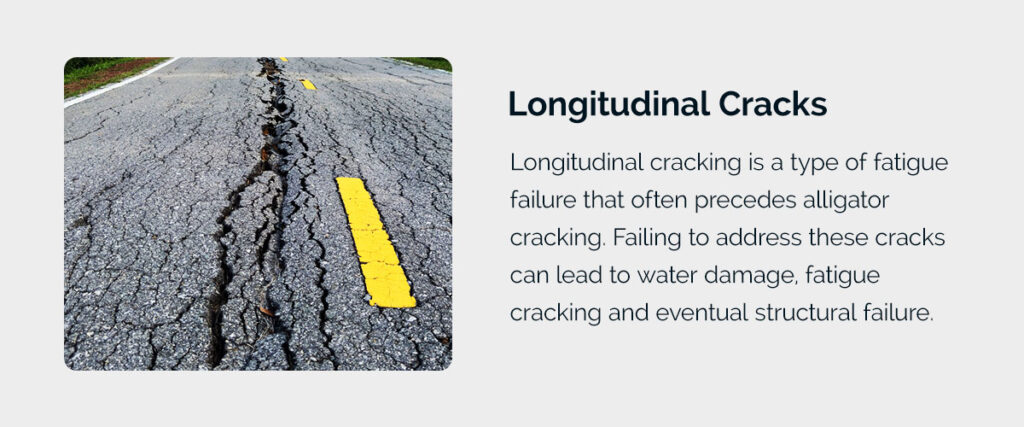
Longitudinal cracking is a type of fatigue failure that often precedes alligator cracking. They run parallel to the laydown direction of the pavement. Failing to address these cracks can lead to water damage, alligator cracking and eventual structural failure.
Possible causes of longitudinal cracking include:
Parking lot crack sealant is an effective repair for low-level distress. High-quality sealant, applied by experienced pavement maintenance professionals at Daniel B. Krieg Inc., ensures lasting and durable results. For severe damage, we remove the cracked asphalt and replace it with a new overlay.
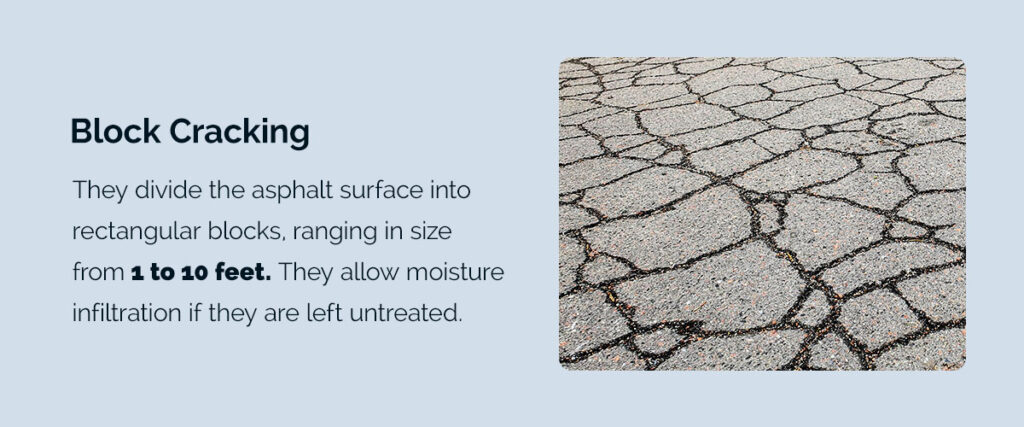
Similar to alligator cracking, block cracking forms interconnected rectangular sections across the pavement surface, ranging in size from 1 to 10 feet.
The severity of block cracking is categorized as:
Block cracking is typically caused by aging or inflexible asphalt binder. Asphalt binder is the insulating material that holds asphalt concrete aggregate together.
Asphalt expands and contracts with temperature changes. When binder loses flexibility, block cracking develops.
Minor block cracking can be sealed using rubberized joint and crack sealants by the pavement maintenance professionals at Daniel B. Krieg, Inc. Severe block cracking requires removing the damaged pavement and installing a new overlay.
Reflection cracks appear in asphalt overlays placed over concrete pavement and mirror the underlying concrete joints. This crack is commonly seen in rigid Portland cement concrete (PCC) pavement parking lots.
Thermal or moisture-related movement of the concrete slab beneath the overlay causes this distress. The severity levels of reflection cracks are identical to block cracking.
Minor cracking can be sealed using rubberized joint and crack sealants by the experts at Daniel B. Krieg, Inc. Severe cracking requires removal of the damaged overlay and pavement replacement.
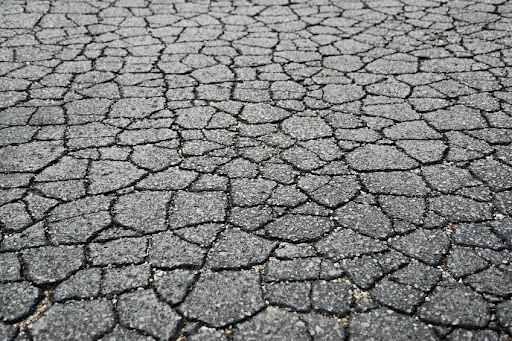
Alligator cracking occurs when asphalt is too thin or built on a weak subgrade. Heavy loads and repeated traffic cause interconnected cracks that resemble alligator scales, most commonly in wheel paths.
According to guides published by the U.S. Department of Transportation, crack severity can range from low to high:
Fatigue cracks have a few possible causes, including:
Proper repair begins with identifying the cause, often through coring and moisture evaluation. Minor alligator cracking requires subgrade repair and drainage improvements, while severe alligator cracking requires full-depth repair or a high-strength asphalt overlay.
Bleeding appears as shiny patches of asphalt binder on the pavement surface. These areas can become slippery in wet conditions and sticky during hot weather.
Bleeding is typically caused by excessive asphalt binder in the mix or surface treatment.
These repair methods can correct the surface issue but not the underlying problem:
Corrugation appears as ripples, while shoving forms wave-like ridges in the asphalt. These issues commonly occur in areas with frequent stopping, starting or where pavement pushes against fixed objects.
Traffic movement combined with unstable asphalt or moisture in the subgrade causes this distress.
Minor and major damaged pavement must be removed. Smaller areas may be patched, while widespread damage requires an overlay.
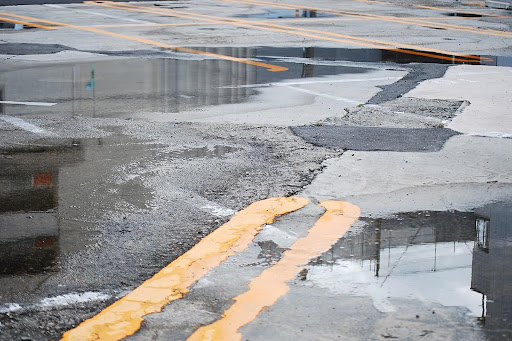
Depressions are sunken areas in the pavement that collect water, sometimes referred to as “bird baths.” Shallow depressions may only be visible after rainfall, while deeper ones increase hydroplaning risk.
The maximum depth of the depression informs the severity:
Depressions typically result from poor construction or soil settlement. Repairs involve removing the affected pavement, correcting the subgrade and patching the surface.
Potholes are bowl-shaped cavities with jagged edges that may extend to the pavement base. They commonly form in parking lots with thin asphalt surfaces and can cause vehicle damage. The severity of a pothole depends on its depth and diameter.
Potholes are often the final stage of fatigue cracking. Fixing a pothole has three possible solutions:
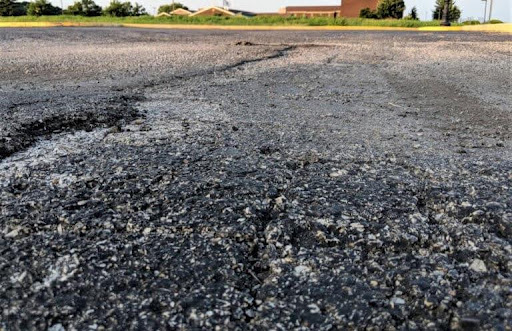
Raveling occurs when aggregate particles loosen and scatter, leaving a rough, deteriorated surface that increases skid and hydroplaning risks. Raveling severity ranges from coarse aggregate loss (medium) to significant surface pitting (high).
Raveling results from the asphalt binder and aggregate bond weakening due to:
Minor raveling can be patched. Extensive raveling requires pavement removal and overlay installation.
Transverse cracks run perpendicular to the pavement direction and follow the same severity scale as block and longitudinal cracking.
Most transverse cracks are caused by thermal contraction, though binder hardening or reflective cracking may also contribute.
Low-severity cracks can be sealed by parking lot experts to prevent water intrusion. Severe cracking requires removal and replacement with an overlay.
By the time pavement distress becomes obvious, damage may already be advanced. Small cracks can quickly evolve into potholes, creating safety hazards, vehicle damage and liability concerns. A neglected parking lot also leaves a poor impression on visitors.
A proactive pavement maintenance approach helps reduce long-term costs, extend pavement life and keep your parking lot safe and accessible.
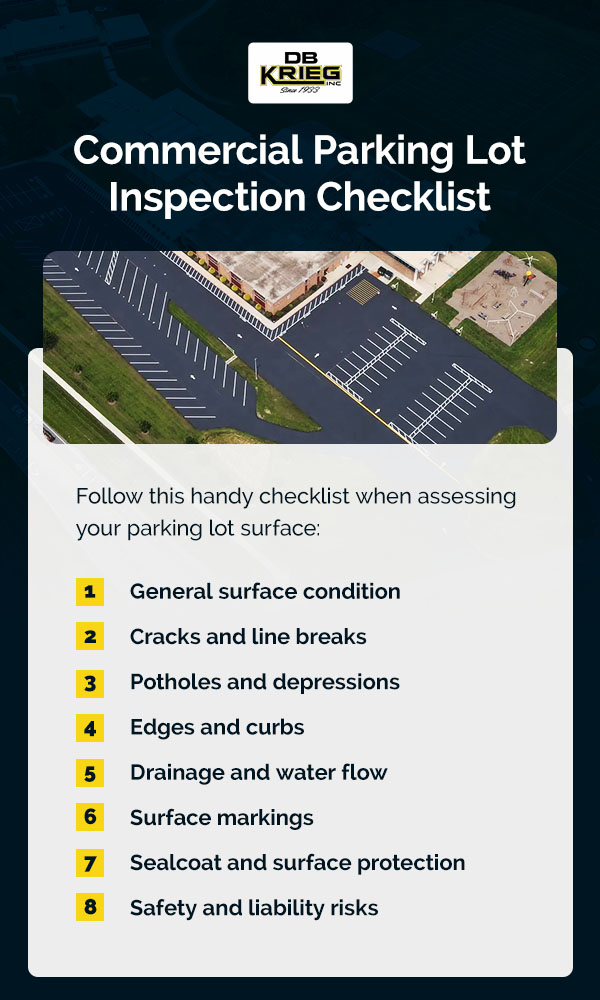
For property managers, regular inspections help catch potential asphalt pavement problems early. Follow this handy checklist when assessing your parking lot surface:
Our professional pavement maintenance services include crack filling and crack repair, sealcoating, asphalt rejuvenation, curb sealing, and line painting.
Since 1933, Daniel B. Krieg has cared for pavements across Pennsylvania. We offer a range of pavement maintenance services and products to keep your parking lot in top condition. From high-quality sealcoating services to reliable crack-filling services, our crews have decades of experience to ensure an exceptional result!
As industry leaders, we combine proven expertise with innovative methods and advanced equipment. We’ve earned the title of Top Commercial Sealcoating Contractor 11 years in a row!
Discover the better way to prevent parking lot distress. Contact us today to discuss your needs or to request a free estimate.