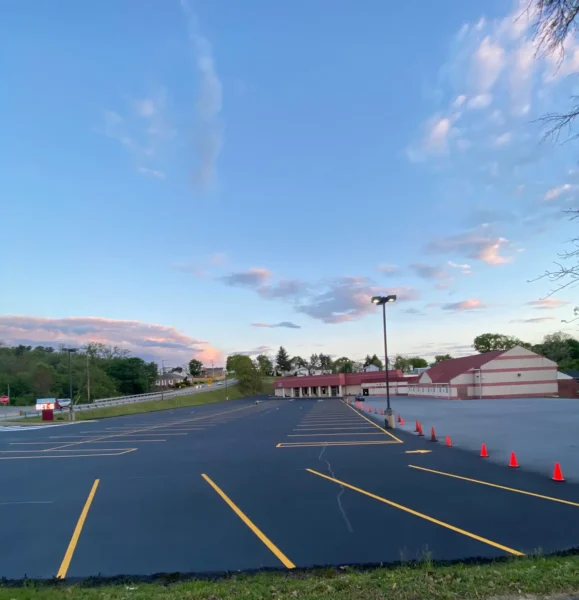
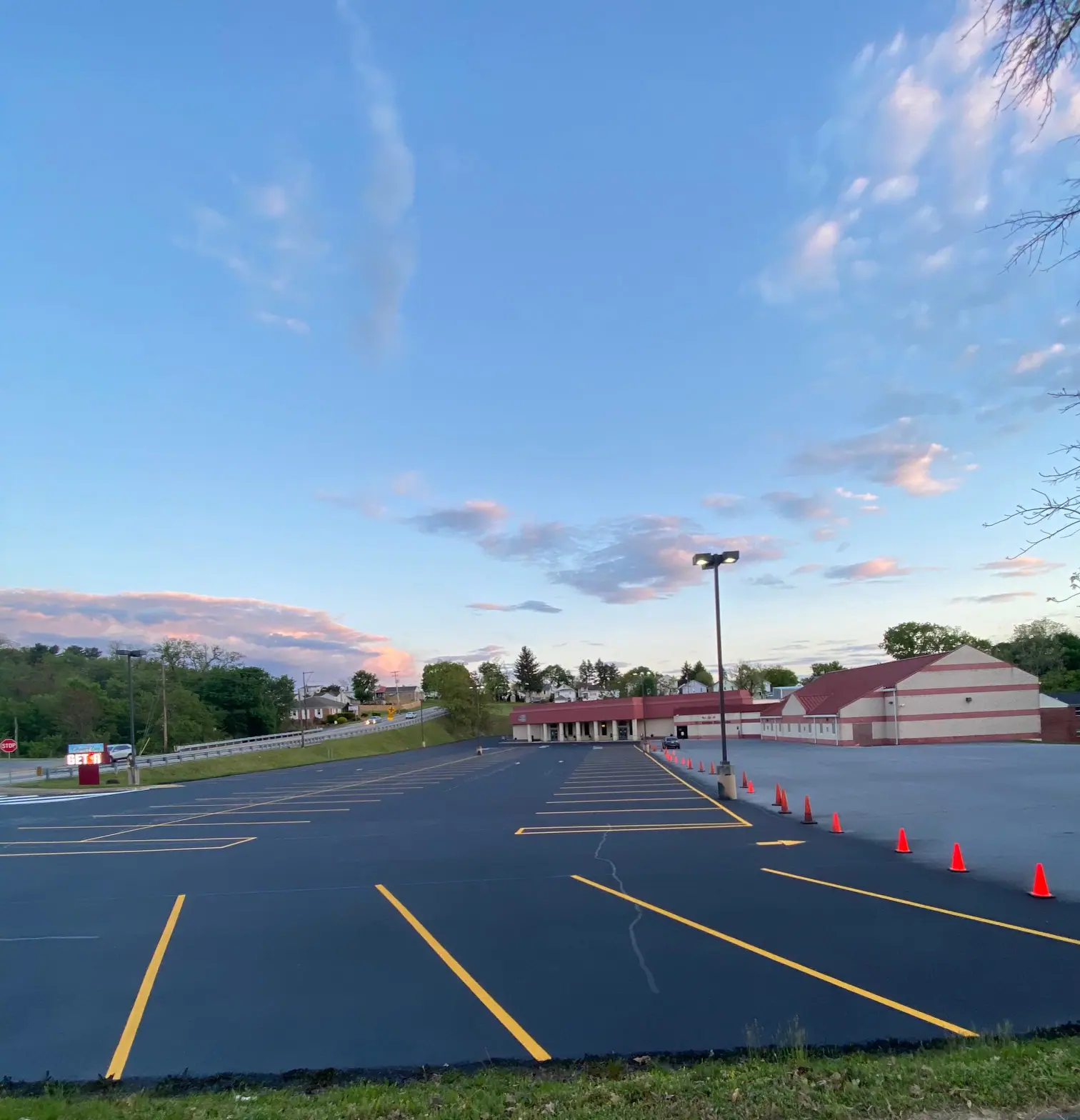
Expert pavement maintenance enhances the appeal of your commercial property, minimizes UV damage to your asphalt, and helps prevent cracks from forming. If you’re a facility or property manager or if you oversee a homeowners association (HOA), maintaining the value and safety of the property is crucial. Whether it’s repairs or maintenance, pavement maintenance projects can disrupt business operations and cause access issues.
Schedule Commercial Pavement Maintenance
The good news? With the right planning and contractor, you can drastically reduce downtime. Learn how to manage your commercial pavement maintenance project efficiently while maintaining productive operations.
The most critical step in minimizing disruption is proactive planning. Waiting until your pavement is full of deep potholes and large cracks forces emergency repairs that maximize disruption. By contrast, scheduling commercial pavement maintenance well in advance allows you to enjoy a streamlined project from start to finish.
A thorough site assessment should focus on both the visible surface conditions and underlying structural factors. It should document all surface issues, including cracks, potholes, grooves and any other damage. The outcome of the assessment should determine the best maintenance strategies and plan work to minimize disruption to facility access and traffic flow.
Try to schedule any maintenance during off-peak days, times and seasons. For instance, find out if any stores are planning a sale, or if someone in your HOA is moving — and try to avoid having maintenance take place at those times. You can also align the project with your business cycles. Scheduling work during slower periods, weekends, or after hours is the most effective way to reduce the impact on tenants and customers.
Understanding the scope and required curing time for different materials and maintenance projects is essential for setting accurate expectations with tenants and customers.
Quick procedures, such as crack filling and minor patching, can often be completed in small, segmented areas without requiring a full lot closure. Cure times are generally very short, often allowing traffic to return to the area within an hour or two. This minimal disruption means you can usually schedule it during periods of low activity.
Sealcoating is a necessary procedure that protects your asphalt from water, oil and ultraviolet (UV) damage. A typical application and cure time requires the area to be closed for 24 to 48 hours. A well-planned schedule is critical, and you must communicate a precise 48-hour no-access window to all tenants and customers.
While often done in conjunction with sealcoating, line painting can also be a stand-alone service to refresh faded markings. Modern, fast-drying paints can cure quickly, sometimes in under an hour. It allows a contractor to stripe zones sequentially, resulting in minimal delay between completing the sealcoat cure and reopening the area for parking.
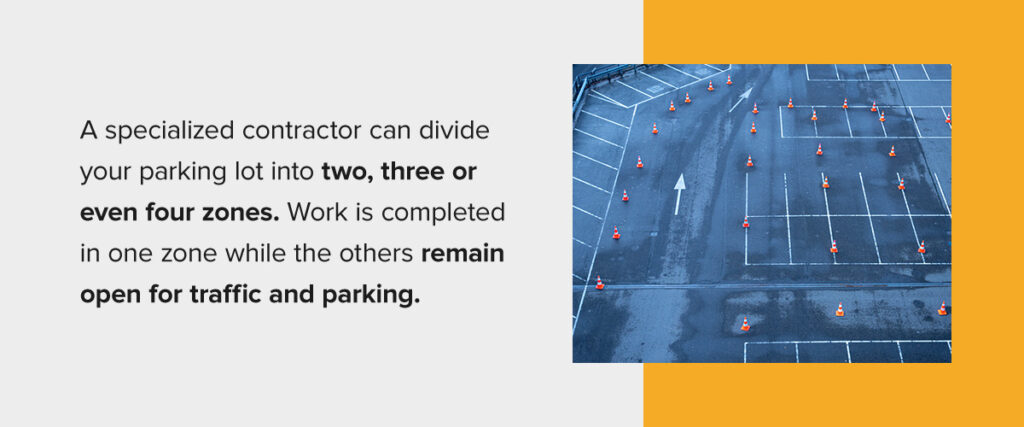
The goal is to avoid a full parking lot closure planning scenario by breaking the project into smaller, manageable zones.
A specialized contractor can divide your parking lot into two, three or even four zones. Our work is completed in one zone while the others remain open for traffic and parking.
This approach offers significant benefits:
With the planning phase over, it’s time to inform the tenants or HOA residents. Tenant communication during pavement maintenance projects is crucial for preventing a frustrating situation and ensuring the project is as hassle-free as possible.
We will ask you to notify your tenants and/or residents, staff, and visitors at least 2-3 weeks in advance with emails, signage, website notices, and social media updates. At Daniel B. Krieg, our team can help you formulate these communications and will provide you with maps/pedestrian routes.
This communication checklist has three phases. By following the list and checking off each phase, you’ll know you’re communicating the pavement maintenance project fairly, clearly and in due time:
As a facility manager, pavement maintenance can be managed effectively with a simple, actionable checklist. This is also invaluable for HOA parking lot maintenance, where resident communication is key.
In the pre-project phase:
In the communication phase:
In the project phase:

At Daniel B. Krieg, Inc., we have perfected the process of crack filling, sealcoating, and line painting commercial parking lots, retail centers, HOAs, warehouses, and more, with very little impact on your daily operations. Our teams:
The result: freshly maintained pavement and a seamless experience for you, your staff, your residents/tenants, and your customers.
Don’t let necessary pavement maintenance become a headache. Contact Daniel B. Krieg today for a free consultation and discover how we make parking lot projects truly stress-free.